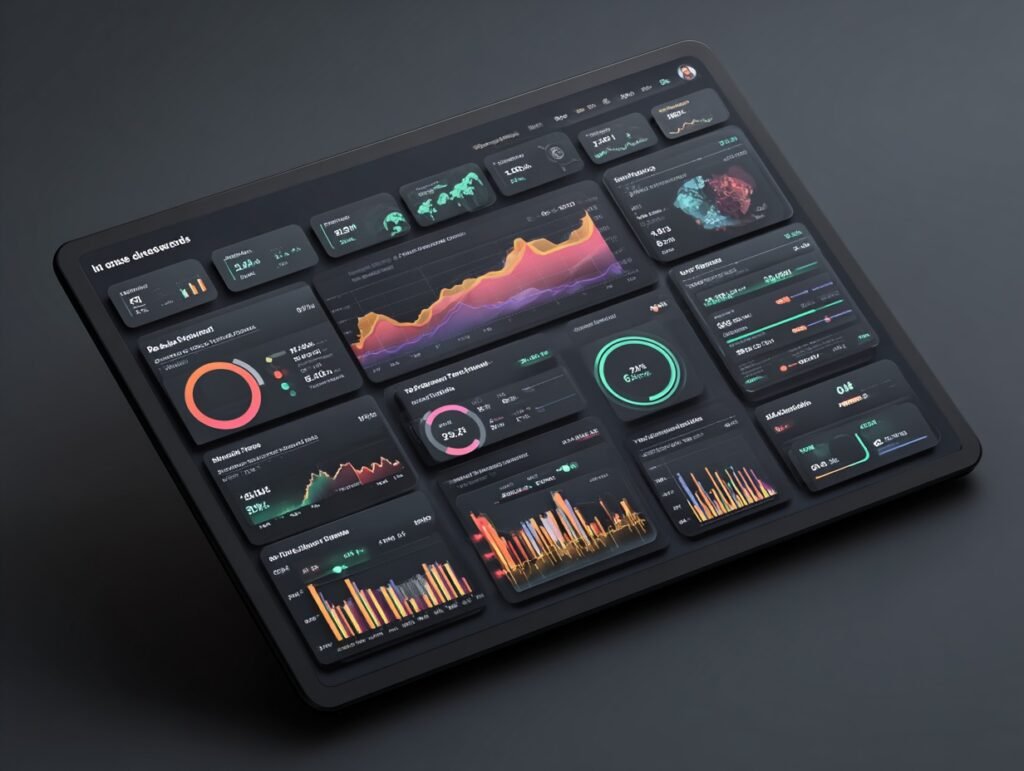

Dashboard design is now a priority in enterprise technology. Leaders in every industry are asking how to turn data into decisive action. The answer is effective design, with the AI executive dashboard playing a central role. When artificial intelligence is integrated, the impact can transform organizations at every level.
Why the AI Executive Dashboard Is Changing Business
Modern leaders need fast, clear data. An AI executive dashboard puts that data right in front of them. It removes guesswork. It replaces long reports with sharp visual insight. Furthermore, it has shifted how companies think about decision-making at the top. Gone are the days when executives waited for weekly slide decks. Today, data arrives in real time and is smart (Senior Executive, 2025). Design is what makes or breaks this tool. A poorly designed dashboard confuses even the most capable leadership team. Therefore, understanding what goes into strong dashboard design is worth every bit of attention you can give it.
What Makes Dashboard Design So Critical
Many organizations have invested heavily in data infrastructure. However, over 60% of business intelligence projects still fail to deliver meaningful insights to leadership (Lets-Viz, 2025). That is a striking number. It points to a design problem, not a data problem. Executives simply do not have time to dig through cluttered screens. Consequently, the best dashboards summarize the state of the business in just a few minutes. They show what is happening, why it is happening, and what to do next. Moreover, when a dashboard clearly answers those three questions, it becomes a daily habit rather than an occasional reference tool. That shift from optional tool to daily habit is where real organizational value starts to build.
How AI Transforms the Dashboard Experience
AI has redefined dashboard capabilities. Once limited to historical charts and tables, dashboards now leverage AI to forecast trends, detect anomalies, and recommend real-time actions (Fuselab Creative, 2025). They also translate raw data into plain-language summaries, saving time and reducing misinterpretation. This shift from passive display to active insight marks a major advance in business intelligence.
Personalization Is at the Heart of Good Design
No two executives need the same view. A chief financial officer thinks in margins and cash flow. A chief operating officer tracks efficiency and throughput. Consequently, role-based dashboard design is now considered a best practice across the industry (UXPin, 2025). AI makes this personalization much easier to achieve. It learns from user behavior over time. It notices which metrics a user checks first and surfaces them more prominently on screen. Moreover, AI adjusts the density of information based on who is looking. An executive sees a clean high-level summary. An analyst, by contrast, gets deeper filters and granular breakdowns. Both views pull from the same underlying data. Therefore, the organization stays aligned without overwhelming non-technical users with unnecessary complexity (Monday.com, 2025).
Designing an AI Executive Dashboard for Clarity
Clarity is the most critical principle in the design of AI executive dashboards. Start with a clear purpose—know the decisions the dashboard should support before designing. This ensures each feature supports actionable insight (UXPin, 2025).
Visual hierarchy matters enormously. The most critical metrics should appear at the top in the largest format. Supporting data flows naturally beneath them. Furthermore, color choices should guide attention rather than simply fill space. Red draws the eye to problems. Green signals health. Neutral tones carry the background so that alerts and highlights stand out clearly. When every design choice serves a real purpose, the result is a dashboard that performs quickly even under heavy pressure.
Real-Time Data and Predictive Analytics
Speed matters at the executive level. Waiting for end-of-week reports was standard practice. Now, however, real-time dashboards have made that wait completely unnecessary. AI dashboards pull from multiple data sources simultaneously (Monday.com, 2025). They process information from databases, cloud applications, and spreadsheets simultaneously. As a result, leaders see what is happening right now, not what happened last Tuesday.
Additionally, predictive analytics adds a powerful extra layer to the picture. AI can analyze historical patterns and accurately predict future outcomes. For example, a trend dashboard might forecast next quarter’s sales based on seasonal data and current pipeline activity. Leaders can then adjust strategy before problems arise rather than reacting after the fact. That proactive capacity is what separates a good dashboard from a truly great one.
Avoiding the Most Common Design Pitfalls
Even well-intentioned dashboard projects go wrong. The most common mistake is trying to show everything at once. When a dashboard includes every available metric, it ends up communicating nothing clearly. Information overload pushes executives away from the tool rather than drawing them in. Furthermore, a Salesforce survey found that 41% of business leaders could not fully use their dashboards due to complexity or poor accessibility (Senior Executive, 2025). That is nearly half of all leaders failing to get value from a tool built specifically for them.
Poor visual hierarchy makes it hard to quickly find what matters most. Another pitfall is building one dashboard that tries to serve every role at once. As discussed earlier, executives, analysts, and operations managers have very different needs. Tailoring each view to its specific audience is essential to both adoption and long-term organizational value.
The Future of the AI Executive Dashboard
The future is moving fast. Conversational interfaces are already appearing in next-generation tools. Executives will soon be able to type a question and receive a response grounded in live organizational data (Senior Executive, 2025). Voice guidance is also emerging. Imagine a dashboard that narrates insights aloud in real time during a board meeting. Furthermore, augmented reality may allow leaders to explore a three-dimensional data landscape using simple gestures.
These ideas are no longer purely speculative. Many of these features are already in early deployment across enterprise platforms worldwide. Moreover, as AI continues to mature, dashboards will shift from being information displays to becoming true strategic partners. They will recommend actions, simulate future scenarios, and flag risks before they grow into full crises. Designing for that future means building flexibility into every layer of the system today.
Building a Dashboard That People Will Use
Design is only half the battle; adoption is the other. The best-designed AI executive dashboard will fail if not used. Involving executives early shapes which metrics appear, how data is presented, and the interface’s responsiveness.
Rolling out the dashboard to a small test group first allows designers to catch friction points before a full organizational launch (Monday.com, 2025). Real-world usage always reveals things that prototype testing misses. Dashboards should be treated as living systems, not finished products. Business conditions change. Priorities shift. Scheduling regular reviews to update key metrics and retire outdated views keeps the tool aligned with current goals. A dashboard that evolves alongside the organization will always outperform one that stays frozen in time.
References
Fuselab Creative. (2025, April 9). Top dashboard design trends for 2025. https://fuselabcreative.com/top-dashboard-design-trends-2025/
Lets-Viz Technologies. (2025, November 21). Executive dashboard best practices: How to design dashboards. https://lets-viz.com/blogs/executive-dashboard-best-practices-design-guide/
Monday.com. (2025, December 14). AI dashboards: Build smarter insights that drive decisions. https://monday.com/blog/project-management/ai-dashboard/
Senior Executive. (2025, November 5). From static to strategic: The future of AI-powered dashboards. https://seniorexecutive.com/next-gen-ai-dashboards/
UXPin. (2025, July 8). Effective dashboard design principles for 2025. https://www.uxpin.com/studio/blog/dashboard-design-principles/