
The world of software development is changing at a breathtaking pace. AI full stack development is right at the center of that shift. Developers everywhere are rethinking how they design, build, test, and ship applications. Moreover, businesses of every size are reorganizing their technical workflows around intelligent tools and automated systems. This transformation is not some distant trend. It is unfolding right now, across industries and development teams worldwide. The strategy you build today will define your results for years to come.
Understanding this shift starts with understanding the scale of change. The global AI market is projected to reach USD 243.70 billion by 2025, growing at an annual rate of 27.67% (Clarusway, 2025). That growth is not happening in a vacuum. It is being driven by developers, architects, and product teams who are embedding AI into every layer of the applications they build. Furthermore, 73% of U.S. companies are now using AI in some capacity (Nucamp, 2025), making AI literacy essential for developers at every level.
What AI Full Stack Development Really Means
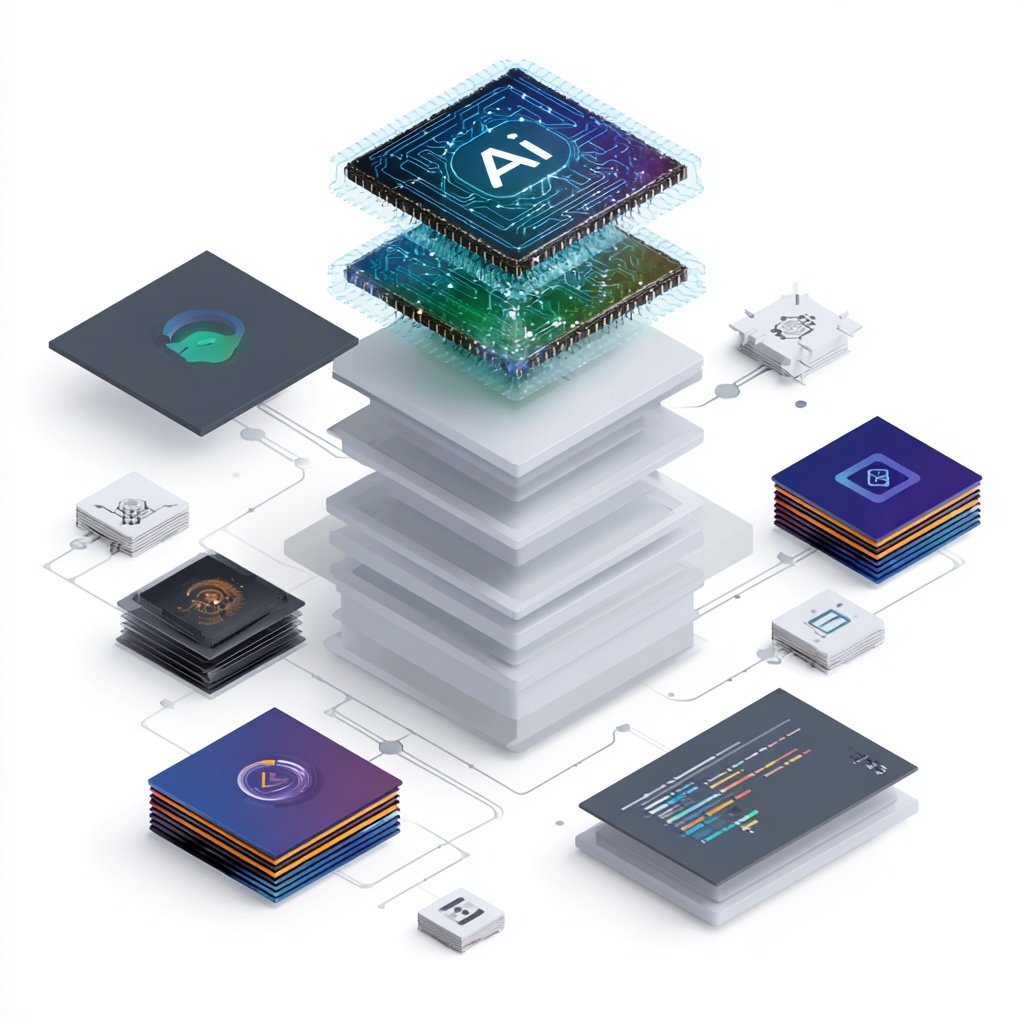
Full stack development has long encompassed both the frontend and backend of a web application. Developers worked across databases, servers, APIs, and user interfaces. That definition, though, is expanding rapidly now. Today, the stack includes AI layers, machine learning models, and intelligent automation tools. According to Intersog (2025), the AI-native full-stack developer has become a high-leverage role capable of architecting, integrating, and evolving AI-driven systems throughout the product lifecycle.
Additionally, frameworks like TensorFlow, PyTorch, and LangChain are no longer optional extras. They are becoming core parts of the modern developer’s toolkit. Furthermore, understanding how to connect AI APIs into both frontend and backend systems is quickly becoming a baseline expectation. Developers who once specialized in React or Node.js are now expected to understand model integration and automation pipelines as well. The shift is broad and picking up speed.
The Tools Reshaping Developer Productivity
The tooling landscape has changed more in the past two years than in the decade before that. Tools like GitHub Copilot are leading that transformation. Research shows that Copilot boosts developer productivity by up to 26% (Clarusway, 2025). More notably, developers using Copilot complete tasks in about one hour that would otherwise take close to three hours. Those numbers are hard to overlook.
Beyond code assistants, AI is also reshaping testing and deployment pipelines. AI-powered testing frameworks can achieve up to 92% bug-detection accuracy (Clarusway, 2025). As a result, teams are catching more issues earlier in the development cycle. That translates into fewer expensive fixes downstream and faster, more reliable releases. Additionally, the 2024 Stack Overflow Developer Survey found that 76% of developers are already using or planning to use AI tools in their workflows (Stack Overflow, 2024). The momentum behind these tools is building steadily and shows no signs of slowing.
Building Your AI Full Stack Development Strategy
A solid strategy starts with skill-building. Developers should not wait for their organizations to mandate AI training. Instead, they should begin experimenting with AI tools in their existing workflows right away. Starting with something familiar, like using Copilot during everyday coding tasks, makes the learning curve much more manageable. Progress builds naturally from there.
Furthermore, a strong AI full stack development strategy must account for a product’s full lifecycle. That means thinking about how AI will be used at the design stage, during development, through testing, and into deployment. It also means planning for how AI models will be monitored and updated after they go live. According to Intersog (2025), the best developers in 2025 are not just shipping clean code. They are shaping workflows, influencing decisions, and accelerating execution across the entire product lifecycle. Strategy, therefore, must be just as broad.
Frontend and Backend in the AI Era
The frontend layer is evolving quickly. Tools like Framer AI and Uizard are layering intelligent design suggestions on top of familiar frameworks like React and Vue. Designers and developers are now working alongside AI assistants that can suggest layouts, generate components, and write responsive CSS from a simple prompt. Consequently, development cycles that once took days are now moving in hours.
On the backend, the changes are equally significant. Python and Node.js remain dominant languages, but machine learning is increasingly being baked directly into business logic. AI APIs from providers like OpenAI and tools like LangChain enable developers to add conversational features, predictive capabilities, and intelligent search to server-side applications. Meanwhile, DevOps is getting smarter as well. Predictive analytics tools are identifying system vulnerabilities before they become real problems, and AI-enabled CI/CD pipelines are automating testing, deployment, and monitoring with impressive precision (BKThemes, 2025).
Trust, Security, and the Human Edge
One of the most important parts of any AI strategy is knowing where to trust the technology and where to apply human judgment. The 2024 Stack Overflow Developer Survey found that while 76% of developers use or plan to use AI tools, only 43% fully trust their accuracy (Stack Overflow, 2024). That gap matters enormously. It means that developers who understand both how to use AI and how to design around its limitations will carry a significant competitive advantage.
Moreover, security is a genuine concern that strategy must address head-on. AI tools can introduce new vulnerabilities if they are not carefully integrated. Additionally, over-reliance on generated code without thorough review can lead to technical debt and subtle bugs that are difficult to trace. The developers and teams that thrive will be those who treat AI as a powerful collaborator rather than an infallible solution. That balance between AI assistance and skilled human oversight is where real quality is produced.
Getting Started Without Feeling Overwhelmed
The path into AI development does not have to feel overwhelming. The most practical approach is incremental. Start by identifying one or two repetitive tasks in your current workflow, then test an AI tool to handle them. Notice what works well and where the tool falls short. Then build from there, gradually expanding how and where you integrate AI into your process.
Beyond individual practice, teams should invest in shared learning. Holding regular knowledge-sharing sessions around new AI tools creates a culture of experimentation and adaptability. Furthermore, staying connected to current research and industry surveys helps teams make smarter decisions about which technologies to adopt. The developers who will define the next era of software are not necessarily the ones with the most experience. They are the ones with the most curiosity. A willingness to learn, experiment, and adapt remains the most valuable skill in this field.
Where AI Full Stack Development Is Heading
AI is not replacing full stack developers. It is raising the ceiling on what a skilled developer can accomplish. The most exciting part of this moment is that the tools are accessible to almost everyone. You do not need a machine learning background to start building smarter applications. What you need is a willingness to learn the new landscape and a clear strategy for navigating it.
Furthermore, the field will only grow more sophisticated over time. As AI models become more capable, the expectations placed on developers will grow right along with them. Developers who invest in building their skills now will be positioned to lead those conversations rather than simply react to them. The global AI market is on track to reach USD 826.70 billion by 2030 (Clarusway, 2025). That trajectory signals enormous demand for developers who know how to build intelligently and strategically.
The bottom line is straightforward. AI full stack development is the defining challenge and opportunity of this decade for the software industry. Teams that build thoughtful, adaptive strategies around these tools today will be the ones setting the pace tomorrow. The transformation is already well underway. The only real question is whether you are building a strategy to lead it or simply reacting to it as it unfolds.
References
BKThemes. (2025, January 12). AI and the full stack developer in 2025. DEV Community. https://dev.to/bkthemes/ai-and-the-full-stack-developer-in-2025-2flo
Clarusway. (2025, January 14). How will AI shape the future of full stack development? https://clarusway.com/ai-future-full-stack-development/
Intersog. (2025, May 7). The AI-native full-stack developer: Redefining engineering impact in 2025. https://intersog.com/blog/strategy/the-ai-native-full-stack-developer-redefining-engineering-impact-in-2025/
Nucamp. (2025, February 24). Embracing AI: How artificial intelligence is revolutionizing full-stack development in 2025. https://www.nucamp.co/blog/coding-bootcamp-full-stack-web-and-mobile-development-2025-embracing-ai-how-artificial-intelligence-is-revolutionizing-fullstack-development-in-2025
Stack Overflow. (2024). Stack Overflow Developer Survey 2024. https://survey.stackoverflow.co/2024/