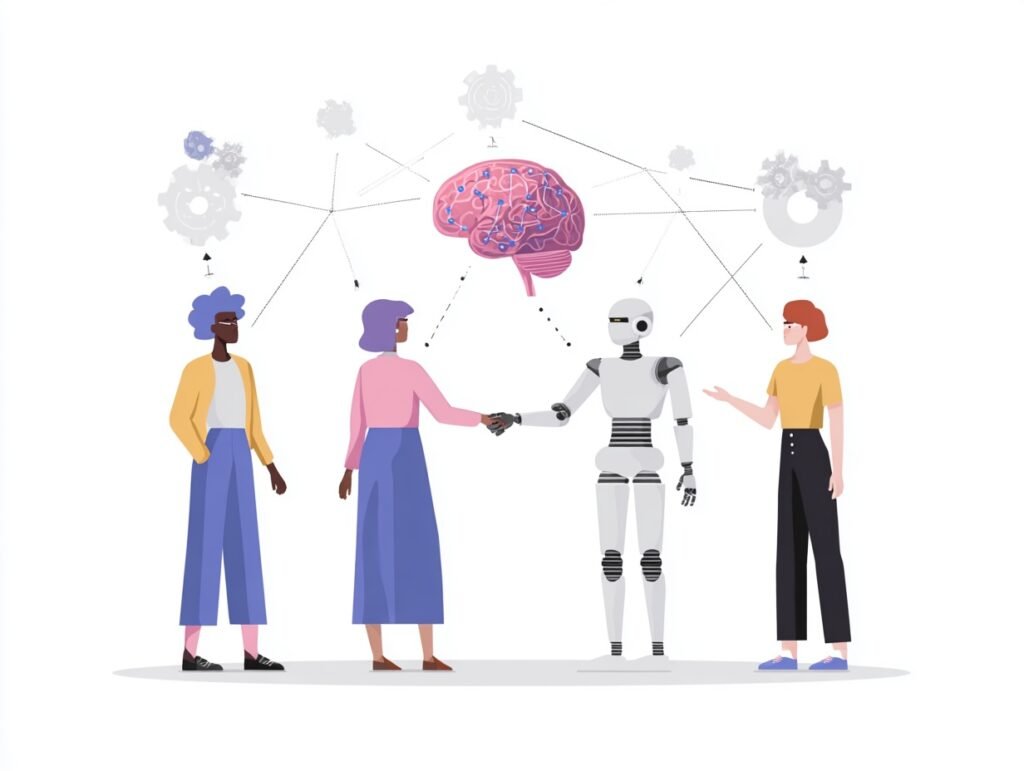

Today, organizations are redefining team dynamics. Artificial intelligence drives this change. The idea of an AI collaboration model has shifted swiftly from theory to application. Companies across industries are learning to embed AI into cross-functional processes. This means uniting marketing, engineering, finance, and operations through AI tools in a coordinated, effective manner. Some organizations lead the way, while others are catching up. Regardless, momentum is clear, and the stakes increase each quarter.
The path ahead is rarely simple. Cross-functional collaboration brings distinct challenges, and integrating AI introduces new concerns regarding accountability, trust, and authority. However, organizations that address these concerns carefully are seeing tangible outcomes. This post clarifies what these models entail, their significance, and how your organization can begin implementing them now.
What Is an AI Collaboration Model?
First, a precise definition is useful. An AI collaboration model is a systematic approach to embedding artificial intelligence tools within team workflows. It is not merely sporadic AI software use. Rather, it defines how humans and AI systems divide tasks, share information, and assign decision-making across the organization. Treat it as a blueprint for human-AI collaboration. The model dictates responsibilities, AI’s role, and communication procedures across departments.
Without a clear model, AI tools often get used in silos, which undermines their value considerably. Seeber et al. (2020) describe AI teammates as systems that require deliberate integration to function well within human teams. That finding reinforces an important truth. You cannot drop a tool into a team’s workflow and expect collaboration to improve on its own. There needs to be structure. Therefore, a well-designed model brings coherence to the entire effort and provides every department with a shared language for working with AI.
How Cross-Functional Teams Are Already Shifting
Cross-functional collaboration has always been complex, with departments working under different priorities, tools, and timelines. AI adds both complexity and opportunity for improvement. Research from McKinsey shows AI-enabled organizations gain in productivity and decision quality across functions (Chui et al., 2023)—a strong reason to build robust AI-integrated practices now.
Moreover, teams that integrate AI early into their workflows tend to outperform those that add it as an afterthought. This is especially true in organizations where data flows freely between departments. When finance, product, and customer success all draw from the same AI-generated insights, alignment happens faster. Consequently, decisions improve, and projects stay on track more consistently. The key is building collaboration structures that support seamless data sharing from the very beginning. Without that structure, even the best AI tools will fall short of their potential.
Understanding Different AI Collaboration Structures
Not all AI collaboration models look the same. There are a few common structures worth understanding before your organization commits to a direction. Some organizations use a centralized model where a dedicated AI team manages tools and distributes insights across all departments from a single hub. Other organizations prefer a decentralized approach where each department owns and operates its own AI tools with a fair amount of autonomy. Then there is the hybrid model, which blends both approaches in a balanced way.
In a hybrid model, departments manage their tools but share a common platform and organization-wide standards. Davenport and Mittal (2022) report that the hybrid approach produces strong results in large organizations by balancing local flexibility with coherence. Smaller organizations may find the decentralized model easier to implement. The right fit depends on team size, data, and leadership. Choosing well from the start prevents later confusion.
Breaking Down Silos with an AI Collaboration Model
Departmental silos have long been a major barrier to organizational agility. Fortunately, AI tools are well-suited to breaking them down in practical ways. Natural language processing tools can translate dense technical reports into plain summaries that any team can understand. Meanwhile, shared AI dashboards give everyone access to the same real-time data. This levels the playing field in cross-functional meetings considerably. When all teams work from the same picture, conversations become more productive, and decisions happen faster.
Additionally, AI systems can flag inconsistencies across departments before they turn into serious problems. A procurement delay identified by an AI tool can trigger an alert to the project management team immediately. As a result, problems get solved before they escalate into something much harder to fix. This kind of proactive, AI-assisted communication is central to any effective AI collaboration model. Therefore, integrating it into your daily processes from the beginning makes a genuine, lasting difference for everyone across the organization.
The Human Side of AI Collaboration
It is tempting to fixate on technology. Yet the human element in AI collaboration is equally, if not more, important. Employees must trust the tools they use. They need to grasp how those tools impact their daily responsibilities. Davenport and Mittal (2022) stress that success with AI relies as much on people and process design as on the technology. This is often overlooked in the excitement of new tools. Ignoring the human factor is among the primary reasons AI efforts falter.
When employees are excluded from the process, adoption slows sharply. Conversely, involving teams in selecting and shaping AI tools boosts engagement. Cross-functional collaboration strengthens when people have true ownership over shared tools. Training is also crucial. Short, role-specific sessions outperform lengthy, generic ones. Investing in employees is essential—not optional—for lasting AI strategies.
Building an AI Collaboration Model for Your Organization
So where do you start? The first step is to carefully assess your current collaboration patterns with fresh eyes. Look at how teams currently share information across departments. Then identify where delays, gaps, or miscommunications most often occur. Next, consider which AI tools could realistically address those specific pain points. Not every solution needs to be complex or expensive to be effective. Sometimes, a simple shared AI writing assistant or data summarization tool is enough to meaningfully improve cross-team communication and coordination.
After that, establish clear roles and expectations for everyone involved in the process. Every team member should know what AI handles and what stays with humans. Clarity reduces friction considerably. Moreover, it builds the kind of trust that makes long-term adoption sustainable. A thoughtful AI collaboration model is built incrementally, not overnight. Starting small and scaling with intention tends to produce far better outcomes than trying to overhaul everything at once. Regular check-ins to evaluate what is and is not working help teams course-correct early.
What the Research Is Saying
The academic and business communities are increasingly focused on how AI reshapes team dynamics in meaningful ways. Brynjolfsson et al. (2023) found that generative AI tools led to meaningful productivity gains, particularly among less-experienced workers operating within structured collaborative workflows. This has important implications for cross-functional teams of all sizes and industries. When AI supports collaboration across varying skill levels and departments, the entire team benefits. That kind of broad lift is exactly what organizations seek when they invest in AI tools.
Furthermore, organizational culture plays a significant role in determining adoption success. Edmondson (2019) argues that psychological safety allows employees to experiment freely with new tools without fear of failure or judgment. That willingness to experiment is exactly what is needed during the early stages of AI integration. In addition, organizations that document their collaboration models tend to refine and improve them more effectively over time. Sharing those learnings across departments accelerates progress and reduces the trial-and-error that slows most teams down in the early going.
Moving Forward with Confidence
AI is not going away. Neither is there a need for strong cross-functional collaboration across organizations of all sizes and types. The good news is that these two things can reinforce each other in genuinely powerful ways. When built thoughtfully, an AI collaboration model helps teams move faster, make better decisions, and communicate more clearly across every department. It also helps organizations stay competitive in a business environment that is changing faster than ever before. That combination of speed and clarity is something every team leader should be actively working toward.
Nevertheless, success requires more than purchasing the right software and hoping for the best. It requires a genuine commitment to process design, people development, and ongoing evaluation of what is working. As AI tools continue to evolve, collaboration models will need to evolve right alongside them. That is why building a culture of adaptability matters so much from the very beginning. Organizations that grow their AI strategies alongside their people will thrive. So start small, stay curious, and keep your teams at the center of every decision you make.
References
Brynjolfsson, E., Li, D., & Raymond, L. R. (2023). Generative AI at work. NBER Working Paper No. 31161. https://www.nber.org/papers/w31161
Chui, M., Hazan, E., Roberts, R., Singla, A., Smaje, K., Sukharevsky, A., Yee, L., & Zemmel, R. (2023). The economic potential of generative AI: The next productivity frontier. McKinsey Global Institute. https://www.mckinsey.com/capabilities/mckinsey-digital/our-insights/the-economic-potential-of-generative-ai-the-next-productivity-frontier
Davenport, T. H., & Mittal, N. (2022). All in on AI: How smart companies win big with artificial intelligence. Harvard Business Review Press.
Edmondson, A. C. (2019). The fearless organization: Creating psychological safety in the workplace for learning, innovation, and growth. Wiley.
Seeber, I., Bittner, E., Briggs, R. O., de Vreede, T., de Vreede, G. J., Elkins, A., Maier, R., Merz, A. B., Oeste-Reiß, S., Randrup, N., Schwabe, G., & Söllner, M. (2020). Machines as teammates: A research agenda on AI in team collaboration. Information & Management, 57(2), 103174. https://doi.org/10.1016/j.im.2019.103174