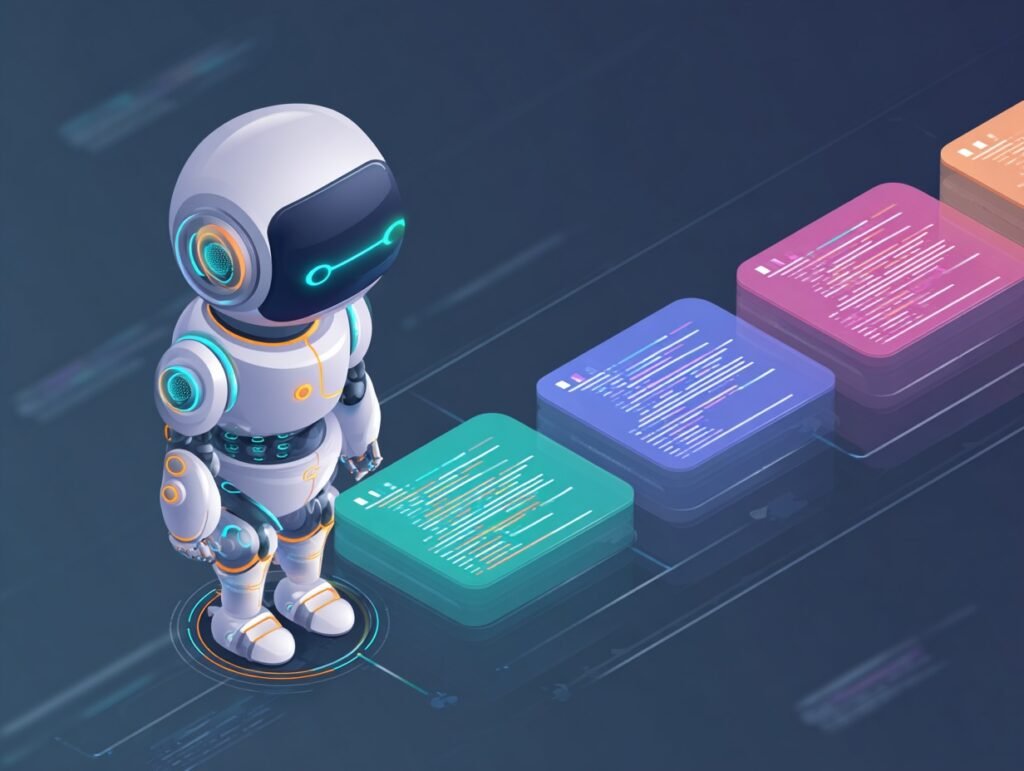

Software development moves fast. Teams push code constantly, so pipelines must keep up. That’s why AI CI automation is transforming DevOps, infusing machine intelligence into build and test workflows. The result: faster releases, smarter quality checks, and fewer production surprises. This post breaks down what that looks like and where the technology is headed.
Now that we’ve seen why AI-driven automation matters for continuous integration, let’s clarify what this technology actually involves. Continuous integration merges code changes frequently into a shared repository. After each merge, automated builds and tests run immediately. Traditionally, teams configured these pipelines by hand—writing scripts, setting up triggers, and monitoring results. That worked well enough for smaller projects.
However, as software systems grow more complex, manual configuration becomes a real bottleneck. AI steps in to handle the intelligence layer. It learns from historical build data, spots recurring failure patterns, and adjusts pipeline behavior accordingly. This shift is what practitioners now call AI CI automation. It moves well beyond simple rule-based triggers into something genuinely adaptive and self-improving (International Journal of Research in Science and Engineering, 2024).
The Rapid Growth of the CI/CD Market
The market numbers make the momentum undeniable. The continuous integration tool market was valued at approximately $34.78 billion USD in 2024. It is projected to grow to over $94 billion by 2035, at a compound annual growth rate of 9.47% (Market Research Future, 2026). That trajectory reflects how central CI/CD pipelines have become to software delivery across industries.
Furthermore, the integration of AI and machine learning is now among the primary drivers of that growth. Teams want pipelines that do more than trigger a build when code lands. They want tools that predict problems before they surface. They want pipelines that recommend fixes without waiting for a developer to intervene. The market is responding accordingly, and investment in AI-enhanced CI tooling continues to climb.
How AI CI Automation Transforms the Pipeline
AI introduces several powerful new capabilities to the CI pipeline. Predictive analytics is one of the most impactful. Rather than reacting to a failed build, AI models analyze historical data and anticipate failure scenarios before they occur (DevOps.com, 2025). That shift from reactive to proactive saves teams significant time and frustration.
Beyond prediction, AI also improves test selection. Running a full test suite on every single commit is expensive and slow. AI can determine which tests are most relevant to a specific code change. As a result, pipeline run times drop without sacrificing coverage. Furthermore, AI supports self-healing workflows. When a build fails, an AI-driven pipeline can sometimes diagnose and resolve the issue automatically. That capability removes a common bottleneck and keeps delivery moving at pace.
AI CI Automation and Security
Security is another domain where AI is rapidly making its mark. Traditional CI pipelines include static code analysis and dependency scanning. Those tools are genuinely useful. Nevertheless, they rely heavily on predefined rules and known vulnerability signatures.
AI goes further. It can detect subtle vulnerability patterns that rule-based tools miss entirely. Additionally, AI supports intelligent dependency analysis, which flags risky third-party updates before they enter the main codebase (Eficode, 2024). As DevSecOps practices spread across the industry, AI is increasingly playing a role in the security layer of the pipeline. Teams are embedding AI-powered security checks directly into their CI workflows. Consequently, security testing no longer waits until the final stages of development. It happens continuously, as code is written and merged, catching issues at the lowest possible cost.
Adoption Is Still Finding Its Footing
Despite all the momentum, real-world adoption of AI in CI/CD workflows is still more limited than the headlines suggest. A 2025 survey by JetBrains found that 73% of respondents reported not using AI in their CI/CD workflows at all (JetBrains, 2025). That figure is striking, given how heavily AI dominates software engineering conversations right now.
The gap between enthusiasm and implementation has practical roots. Cost remains a significant barrier. Many organizations find AI-enhanced CI solutions prohibitively expensive for broad deployment. Beyond cost, teams are genuinely unsure about the value AI brings to their specific workflows. Security concerns add another layer of hesitation. Introducing AI into build and deployment pipelines raises legitimate questions about code integrity, data protection, and regulatory compliance. Even so, the industry’s direction is unmistakable. As tools mature and pricing becomes more accessible, broader adoption is only a matter of time.
Predictive Analytics and Smarter Builds
One of the most compelling aspects of AI CI automation is the predictive analytics it enables to improve efficiency. AI models forecast peak resource demands and anticipate when pipelines are likely to buckle under load (DevOps.com, 2025). That kind of foresight transforms how performance is managed at scale. Rather than scrambling after a failure, teams can take preventive action well in advance.
Moreover, predictive analytics helps with resource allocation. CI/CD pipelines consume significant cloud compute, so wasted resources add up quickly. AI optimizes when and how resources are provisioned, cutting unnecessary spend and improving throughput. Faster builds and fewer failures mean shorter release cycles, leading to more frequent delivery of value to end users. Over time, those gains become a competitive advantage for teams that excel here.
The Human Element Still Matters
AI does not replace developers. It amplifies what they can accomplish. That distinction matters more than it might seem at first. Some practitioners worry that heavy reliance on AI-driven pipelines will gradually erode deep technical expertise within engineering teams (Eficode, 2024). That concern deserves to be taken seriously. Over-reliance on automated suggestions can reduce a team’s understanding of their systems. The best approach is to treat AI as a complement to human judgment, not a replacement for it. Engineers still need to evaluate AI recommendations critically and push back when needed. The goal is a partnership: AI handles repetitive, data-intensive tasks; humans focus on architecture, strategy, and creative problem-solving. This balance makes AI CI automation sustainable and effective in the long term. run.
Looking Ahead for AI CI Automation
The trajectory for AI in continuous integration is clearly upward. Market projections remain strong through the next decade (Market Research Future, 2026). Research continues to validate the real-world performance gains that AI-driven CI delivers (International Journal of Research in Science and Engineering, 2024). As large language models continue to improve, they will take on increasingly complex pipeline configuration tasks. Eventually, developers may describe a pipeline in plain language and let the AI generate the full configuration automatically. That future is nearer than it appears.
For now, the teams investing in understanding AI CI automation will be better positioned as the tools continue to mature. Getting started does not require a complete overhaul of existing infrastructure. Small experiments with AI-assisted test selection or predictive build analytics can deliver meaningful wins quickly. From there, teams can thoughtfully expand their use of AI, building confidence at each step. The pipeline of the future is already taking shape. The best time to start exploring it is now.
References
International Journal of Research in Science and Engineering. (2024). AI-driven continuous integration and continuous deployment in software engineering. https://www.researchgate.net/publication/379772841_AI-Driven_Continuous_Integration_and_Continuous_Deployment_in_Software_Engineering
Market Research Future. (2026). Continuous integration tool market size, analysis 2035. https://www.marketresearchfuture.com/reports/continuous-integration-tool-market-28744
JetBrains. (2025). The state of CI/CD in 2025. https://blog.jetbrains.com/teamcity/2025/10/the-state-of-cicd/
DevOps.com. (2025). AI-powered DevOps. Transforming CI/CD pipelines for intelligent automation. https://devops.com/ai-powered-devops-transforming-ci-cd-pipelines-for-intelligent-automation-2/
Eficode. (2024). Transforming software development with AI and DevOps. https://www.eficode.com/transforming-software-development-with-ai-and-devops