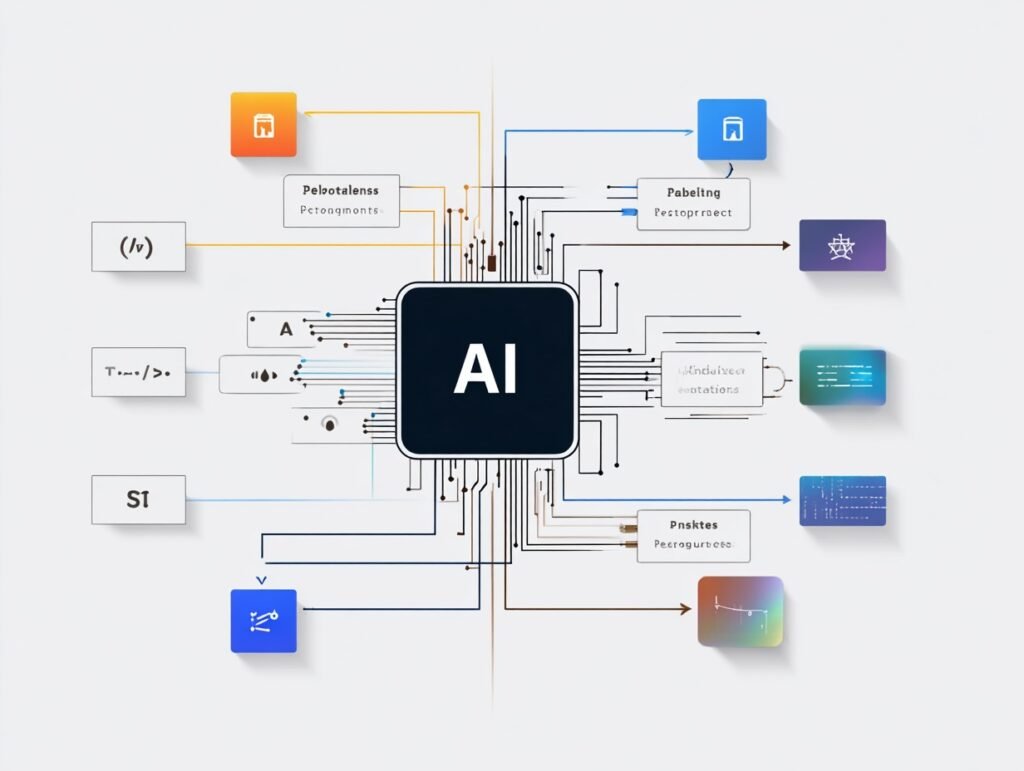

Understanding AI Backend Development Patterns
The software landscape is shifting rapidly. Developers are reimagining backend foundations. AI backend development patterns are now core to creating scalable, intelligent applications that handle real-world stress. These patterns provide practical guidance for structuring code, data pipelines, and inference layers—blueprints that engineering teams use daily.
These patterns are increasingly crucial. Unlike traditional web requests, AI workloads are heavier, stateful, and unpredictable. Choosing the right patterns early avoids major setbacks. Paleyes et al. (2022) emphasize that reliable ML deployment is challenging, and failures often stem from weak foundational decisions.
Why Architecture Decisions Shape Everything
Many teams rush into building, quickly wiring up a model and serving requests. This may work initially, but it often fails under real-world load. Solid architecture is the foundation for downstream success.
AI systems are uniquely complex. They blend data engineering, model inference, and API design. Each layer must communicate cleanly. Shankar et al. (2022) found that friction in AI systems often stems from weak backend architecture rather than from model quality. The models were fine—the plumbing was not.
Therefore, choosing an architecture is not just a technical task. It is a business decision with long-term consequences. Poor patterns lead to bottlenecks and costly outages. Strong patterns lead to resilient systems that grow gracefully with demand. Getting this right from the start saves painful, expensive refactoring later.
Common AI Backend Development Patterns in Practice
Several patterns recur in production AI systems. The model-as-a-service pattern treats each trained model as an independent microservice. This makes deployment clean and modular. Teams can update or replace a single model without touching the rest of the system.
Additionally, the pipeline pattern is widely used. It connects preprocessing, inference, and postprocessing as discrete, testable steps. Each step can be developed and scaled independently. This reduces the risk of tangled, fragile code that is hard to debug.
Moreover, the event-driven pattern is gaining popularity across modern AI backends. In this approach, incoming requests trigger background inference jobs (tasks done by AI models behind the scenes) rather than blocking synchronous calls (waiting for a direct response before continuing). This significantly reduces perceived latency—the time users wait for results. It also makes the system more resilient when traffic spikes unexpectedly. As a result, teams adopting event-driven patterns tend to achieve better performance and fewer cascading failures than with purely synchronous designs.
Managing Data Pipelines Effectively
Data powers every AI system. Without reliable, clean data in the backend, even robust models fail. Effectively managing data pipelines is fundamental, not optional.
Teams must carefully plan data entry at every stage. Ingestion layers handle a range of formats and volumes. Transformation logic should be versioned and reproducible. Validation checks catch bad data before it reaches the model.
Furthermore, data lineage tracking (the recording of data’s origins and changes) has become a standard expectation in mature AI backends. Engineers need to know where data came from, how it was transformed, and when it last changed. Lwakatare et al. (2020) observed that poor data pipeline management is a leading cause of silent failures in large-scale machine learning systems. Thus, investing in robust pipeline infrastructure pays off significantly as systems grow and evolve over time.
Scaling AI Backends Without Breaking Things
Scaling challenges are common for AI systems. Unlike traditional backends, AI scaling involves more than adding servers. Model inference is resource-intensive, and hardware selections are critical.
Therefore, teams often separate the inference layer from the application layer entirely. This allows each layer to scale independently based on its own demands. The application layer handles routing and business logic at a lower cost. The inference layer handles heavy GPU or CPU computation separately.
Caching plays a significant, often underestimated role in AI backends. Many requests are similar, so cached responses can be served instantly, reducing latency and infrastructure cost. However, caching must be handled carefully, as stale responses can mislead users or trigger downstream errors. Paleyes et al. (2022) highlighted caching strategies as an impactful optimization in production AI systems.
Batching is another crucial technique. Instead of handling requests one at a time, batch groups of multiple requests before sending them to the model. This better utilizes GPU parallelism, increasing throughput while reducing per-request costs.
Observability and Monitoring in AI Systems
Sculley et al. (2015) coined the term “hidden technical debt” to describe the invisible complexity that accumulates over time in machine learning systems. Their work remains deeply relevant today. AI systems degrade in subtle ways. A model that performed well last month may perform poorly today with no code changes.
Observability in AI backends goes well beyond standard application logging (recording basic system events). Teams need to continuously track model performance metrics (measurable statistics about effectiveness). They need to detect data drift, which occurs when incoming data diverges from the data the model was trained on. They also need to monitor latency (response time), error rates, and throughput (number of requests handled) on an ongoing basis.
Alerting should be proactive, not reactive. Automated alerts must flag anomalies as soon as key metrics fall out of range. Early detection gives teams time to respond before users are affected. Designing observability from the outset is far less disruptive than adding it later.
Security Considerations in AI Backend Development Patterns
Security in AI backends deserves serious and sustained attention. Many teams focus heavily on model performance while overlooking security. This is a costly mistake that can have serious consequences. AI systems frequently handle sensitive data, including personal information, financial records, and confidential business inputs.
Therefore, access control must be implemented at every layer of the stack. Authentication and authorization should be enforced at the API gateway, the data layer, and the inference service. No component should trust another by default without verification.
Prompt injection is an emerging threat to large language model backends. Malicious inputs can manipulate a model into revealing sensitive information or behaving in unexpected ways. Sanitizing and validating inputs before they reach the model helps defend against this. Data at rest and in transit must always be encrypted, and audit logging should capture access details. These are baseline requirements for production AI backends.
Building for the Future with AI Backend Development Patterns
The field moves quickly and shows no sign of slowing. New model architectures appear regularly. Infrastructure tools are maturing fast. Teams using adaptable AI backend patterns are better positioned to adopt new capabilities without major system rewrites.
Consequently, modularity is the most important long-term design principle in this space. Loosely coupled services can be swapped or upgraded independently without cascading changes. A new model can replace an old one without touching the data pipeline or the application logic surrounding it. This makes system evolution both cheap and low-risk over time.
Furthermore, the rise of multi-model architectures adds new layers of complexity to consider. Many modern applications chain multiple AI models together in sequence. Each model handles a different subtask. Routing logic must determine which model handles each request type. Kreuzberger et al. (2023) described multi-model orchestration as a core challenge in next-generation MLOps systems and called for standardized patterns to manage these pipelines effectively. Following those emerging standards now will reduce the cost of keeping up later.
References
Kreuzberger, D., Kühl, N., & Hirschl, S. (2023). Machine learning operations (MLOps): Overview, definition, and architecture. IEEE Access, 11, 31866–31879. https://doi.org/10.1109/ACCESS.2023.3262138
Lwakatare, L. E., Raj, A., Crnkovic, I., Bosch, J., & Olsson, H. H. (2020). Large-scale machine learning systems in real-world industrial settings: A review of challenges and solutions. Information and Software Technology, 127, 106368. https://doi.org/10.1016/j.infsof.2020.106368
Paleyes, A., Urma, R. G., & Lawrence, N. D. (2022). Challenges in deploying machine learning: A survey of case studies. ACM Computing Surveys, 55(6), 1–29. https://doi.org/10.1145/3533378
Sculley, D., Holt, G., Golovin, D., Davydov, E., Phillips, T., Ebner, D., Chaudhary, V., Young, M., Crespo, J., & Croft, D. (2015). Hidden technical debt in machine learning systems. Advances in Neural Information Processing Systems, 28. https://papers.nips.cc/paper_files/paper/2015/hash/86df7dcfd896fcaf2674f757a2463eba-Abstract.html
Shankar, S., Garcia, R., Hellerstein, J., & Parameswaran, A. (2022). Operationalizing machine learning: An interview study. arXiv preprint arXiv:2209.09125. https://arxiv.org/abs/2209.09125