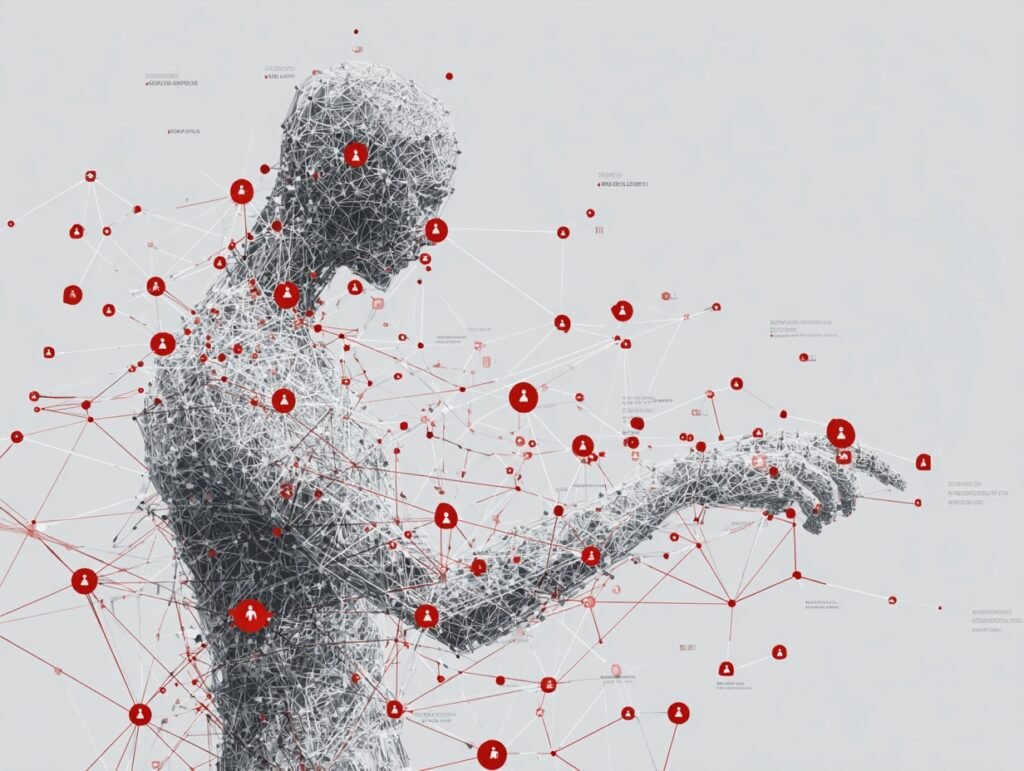

The cybersecurity landscape is evolving at an unprecedented pace. Threats are growing faster and becoming smarter. That is exactly why AI threat intelligence models have become so important in modern defense strategies. These models use artificial intelligence to collect, process, and correlate vast amounts of threat data in real time. They connect dots that human analysts might otherwise miss.
What Are AI Threat Intelligence Models?
AI threat intelligence models turn raw security data into actionable insights. They collect signals across an entire digital footprint and leverage external feeds, dark web data, and global incident reports to build a fuller picture of threats.
Traditional threat intelligence depended on manual analysis, which was slow and prone to human error. AI changes this dynamic. Using machine learning and graph-based techniques, these models uncover relationships among indicators, campaigns, and threat actors far more quickly than any human team (Abou Assi et al., 2026). The outcome is a richer, more contextualized view of every threat your organization faces.
How Correlation Works in AI Threat Intelligence Models
Correlation is what makes these systems so powerful. Instead of examining alerts in isolation, AI threat intelligence models connect events across data sources. For example, an AI system might link a suspicious email to a flagged IP address in firewall logs, revealing a coordinated attack in progress. This cross-platform correlation, once time-consuming, now happens in seconds.
Moreover, modern AI platforms enrich each data point with contextual details. These details include threat actor profiles, historical attack patterns, and potential impact scenarios. By doing this automatically, they transform isolated signals into a unified and coherent picture of an unfolding incident. Consequently, security teams can respond to threats much more quickly and precisely than before.
Machine Learning and Pattern Recognition
Machine learning gives threat intelligence predictive power. Traditional tools matched known signatures. AI models detect behavioral drift, spotting quiet signals before incidents occur (Abou Assi et al., 2026). For example, odd authentication or privilege escalation can signal an attacker preparing.
Additionally, probabilistic models assess each threat’s urgency and risk, allowing teams to prioritize. Instead of chasing every alert, analysts focus on real threats. This improves security outcomes. Organizations using predictive models often catch adversaries in the reconnaissance phase—before damage is done.
Real-World Threats Driving the Need for AI Threat Intelligence Models
The need for robust correlation capabilities has never been more urgent. According to IBM’s 2026 X-Force Threat Intelligence Index, vulnerability exploitation became the leading cause of attacks in 2025, accounting for 40% of all observed incidents (IBM, 2026). Furthermore, active ransomware and extortion groups surged by 49% year over year. Those numbers paint a stark and demanding picture for every security team.
Nation-state actors have become more skilled in using AI. In Q4 2025, Google found state-sponsored actors using large language models to accelerate reconnaissance, refine phishing, and map structures (Google Threat Intelligence Group, 2026). Defenders need equally advanced AI models to counter evolving tactics.
Nation-State Actors and AI-Enabled Attacks
Nation-state groups now use AI for more than basic gains. Google’s research discovered the first malware family that used AI mid-execution to alter its behavior during 2025 (Google Threat Intelligence Group, 2025). This is a major shift—defenders cannot rely solely on static detection.
Furthermore, groups linked to North Korea, Iran, China, and Russia have been observed using large language models throughout the entire attack lifecycle. They use AI for initial reconnaissance, payload creation, lateral movement support, and data exfiltration planning (Google Threat Intelligence Group, 2025). As a result, the challenge of defending against correlation grows more complex with every passing month. AI-driven correlation systems must therefore evolve just as rapidly as the threats they are designed to detect.
How Microsoft Applies AI Correlation at Scale
Microsoft’s AI-driven threat platform tracks over 300 unique actors, including 160 nation-state and 50 ransomware groups. Automated systems continuously analyze and correlate their attributes, revealing attempts to evade detection or expand capabilities (Microsoft, 2024).
Additionally, Microsoft collaborates closely with OpenAI to monitor attack activity tied to known threat groups. Together, they have documented how threat actors use large language models as offensive productivity tools. By studying those patterns closely and continuously, Microsoft continuously refines its own defensive models. This illustrates how AI correlation works not just as a one-time detection tool but also as an ongoing, self-improving learning system.
The Human-AI Partnership in Threat Defense
Even top AI models benefit from human judgment. AI processes data at scale, never fatigued or missing correlations from alert overload. But humans provide context that machines cannot. Analysts understand business operations and know when an anomaly means a real change, not just an incident.
Therefore, the most effective security operations deliberately combine both strengths. AI handles the heavy lifting of correlation and pattern detection. Human analysts then validate findings and direct the response. Together, they create a layered defense that is far more resilient than either could achieve alone. This partnership is increasingly recognized across the industry as the foundation of modern and sustainable threat intelligence operations.
The Road Ahead for AI Threat Intelligence Models
Looking ahead, AI threat intelligence models will continue to evolve rapidly. Researchers are already defining unified architectures that integrate data collection, enrichment, correlation, prioritization, and operationalization within a single coherent framework (Abou Assi et al., 2026). Consequently, these systems will become far more seamless in day-to-day operation. Federated intelligence sharing, autonomous AI agents, and deeper human-AI collaboration are all on the near horizon.
At the same time, adversaries are clearly not standing still. The arms race between attackers and defenders is entering a genuinely new phase. Organizations that invest now in strong AI-driven correlation capabilities will be far better positioned to withstand whatever the next generation of threats delivers. It is critical to act now—prioritize building AI threat intelligence models into the core of your security strategy without delay.
AI threat intelligence models are just one piece of the larger puzzle. To see how artificial intelligence is reshaping the entire security field, read AI for Cybersecurity Professionals.
References
Abou Assi, R., Khalil, I., Khreishah, A., & Abutaleb, A. (2026). Redefining cyber threat intelligence with artificial intelligence. Applied Sciences, 16(3), 1668. https://www.mdpi.com/2076-3417/16/3/1668
Google Threat Intelligence Group. (2025, November). GTIG AI threat tracker: Advances in threat actor usage of AI tools. Google Cloud Blog. https://cloud.google.com/blog/topics/threat-intelligence/threat-actor-usage-of-ai-tools
Google Threat Intelligence Group. (2026, February). GTIG AI threat tracker: Distillation, experimentation, and integration of AI for adversarial use. Google Cloud Blog. https://cloud.google.com/blog/topics/threat-intelligence/distillation-experimentation-integration-ai-adversarial-use
IBM. (2026, February 25). IBM 2026 X-Force threat intelligence index. IBM Newsroom. https://newsroom.ibm.com/2026-02-25-ibm-2026-x-force-threat-index-ai-driven-attacks-are-escalating-as-basic-security-gaps-leave-enterprises-exposed
Microsoft. (2024, February 14). Staying ahead of threat actors in the age of AI. Microsoft Security Blog. https://www.microsoft.com/en-us/security/blog/2024/02/14/staying-ahead-of-threat-actors-in-the-age-of-ai