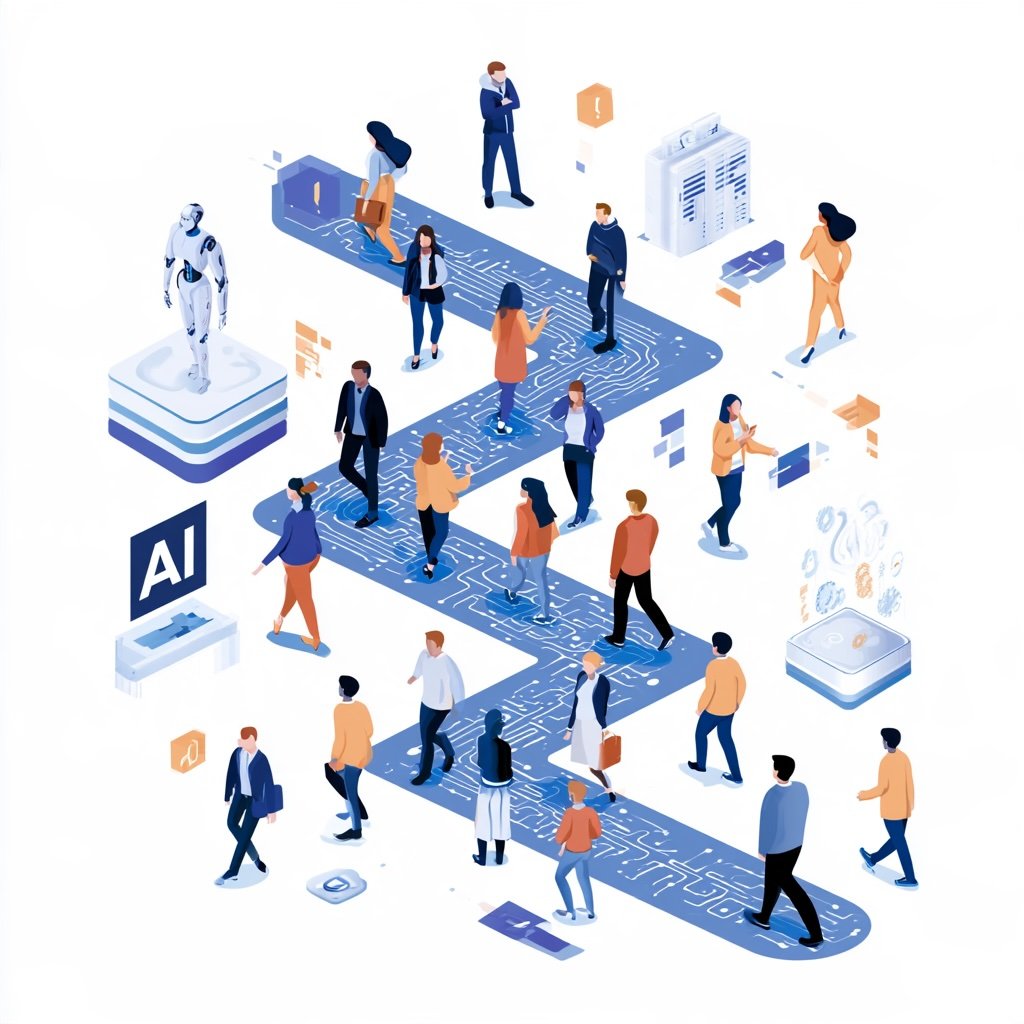

Most companies know their people need AI skills. However, many training efforts stall after a single workshop. Employees attend, nod along, and then go back to old habits. That is where well-designed AI learning paths make a difference. Instead of one-off events, they guide people through a clear sequence of skills. So let’s look at how to build paths that stick.
Why AI Learning Paths Beat One-Off Training
The pace of change is the main reason. The World Economic Forum expects 39 percent of workers’ core skills to change between 2025 and 2030 (World Economic Forum, 2025). Furthermore, it estimates that 59 out of every 100 workers will need training by 2030. A single course cannot keep up with that kind of shift.
By contrast, a learning path builds skills in layers. Each step prepares people for the next one. As a result, learners gain confidence gradually instead of feeling overwhelmed. Additionally, paths give managers a shared language for progress. Everyone knows what beginner, intermediate, and advanced look like. That clarity makes planning, coaching, and promotions much easier.
Start With Roles, Not Tools
Many programs begin with a roundup of popular apps. Unfortunately, that approach quickly goes out of date. Tools change every few months. Roles and goals change far more slowly. Therefore, design around what each job needs to accomplish. This matters more than ever, since IBM found that 54 percent of CEOs are hiring for AI-related roles that did not exist a year earlier (IBM, 2025).
For example, a marketer may need to draft content, analyze campaign data, and personalize messages. Meanwhile, a finance analyst may focus on forecasting and reporting. Similarly, a support lead may need to manage AI agents and review their output. Each role calls for a different mix of skills.
So begin by mapping two or three key tasks for each group. Then identify where AI can help with those tasks. This keeps training practical. Even better, employees see an immediate connection between new skills and the work on their desk.
Build Clear Stages of Skill
Once roles are mapped, organize the path into stages. A simple three-stage model works well for most teams.
The foundation stage covers core concepts. Learners find out what AI can and cannot do, how to write good prompts, and how to check outputs for errors. It also covers privacy and responsible use.
Next comes the applied stage. Here, people practice AI on real tasks from their own jobs. Short projects work far better than lectures. Notably, LinkedIn found that organizations with strong career development programs lean heavily on project-based learning to build new skills (LinkedIn, 2025).
Finally, the advanced stage focuses on redesigning workflows. At this point, learners look for bigger opportunities. They might automate a recurring report or build a simple agent for their team.
Connect Learning to Careers
People pick up skills faster when they see a future in it. LinkedIn’s research shows a strong link between career development and AI adoption. Among organizations with mature career programs, 51 percent say they lead or accelerate generative AI adoption. That compares to 36 percent of other organizations (LinkedIn, 2025).
So tie your AI learning paths to real opportunities. Completing a stage might unlock a new project, a stretch assignment, or eligibility for an internal role. Likewise, recognize progress publicly. Badges, team shoutouts, and manager check-ins all reinforce momentum.
Meanwhile, managers play a critical role. Encourage them to discuss AI goals during regular one-on-ones. When leaders model curiosity, employees feel safer experimenting.
Measure and Refresh Your AI Learning Paths
No path should stay frozen. AI capabilities shift quickly, so content needs regular updates. Plan a review every quarter. Remove outdated lessons and add new use cases as they emerge.
Equally important, measure outcomes beyond completion rates. Finished courses do not prove much on their own. Instead, track changes in work. Are tasks getting done faster? Are errors dropping? Are employees proposing new automation ideas? These signals show whether training creates value.
Also, gather learner feedback often. Ask what felt useful and what felt like busywork. Then adjust. Over time, this cycle turns your program into a living system that grows with your organization.
Bringing It All Together
Designing effective AI training is less about flashy courses and more about structure. Start with roles and real tasks. Build clear stages from basics to advanced practice. Then connect progress to careers and measure what changes on the job. With that foundation, your people will not just keep up with AI. They will help lead the way. Start with one team, refine the approach, then expand across the company.
References
IBM. (2025, May 6). IBM study: CEOs double down on AI while navigating enterprise hurdles [Press release].
https://newsroom.ibm.com/2025-05-06-ibm-study-ceos-double-down-on-ai-while-navigating-enterprise-hurdles
LinkedIn. (2025). 2025 workplace learning report: The rise of career champions. LinkedIn Talent Community.
https://tcommunity.linkedin.com/talent-industry-insights-46/2025-workplace-learning-report-the-rise-of-career-champions-1266
World Economic Forum. (2025, January 7). The future of jobs report 2025.
https://www.weforum.org/reports/the-future-of-jobs-report-2025/digest