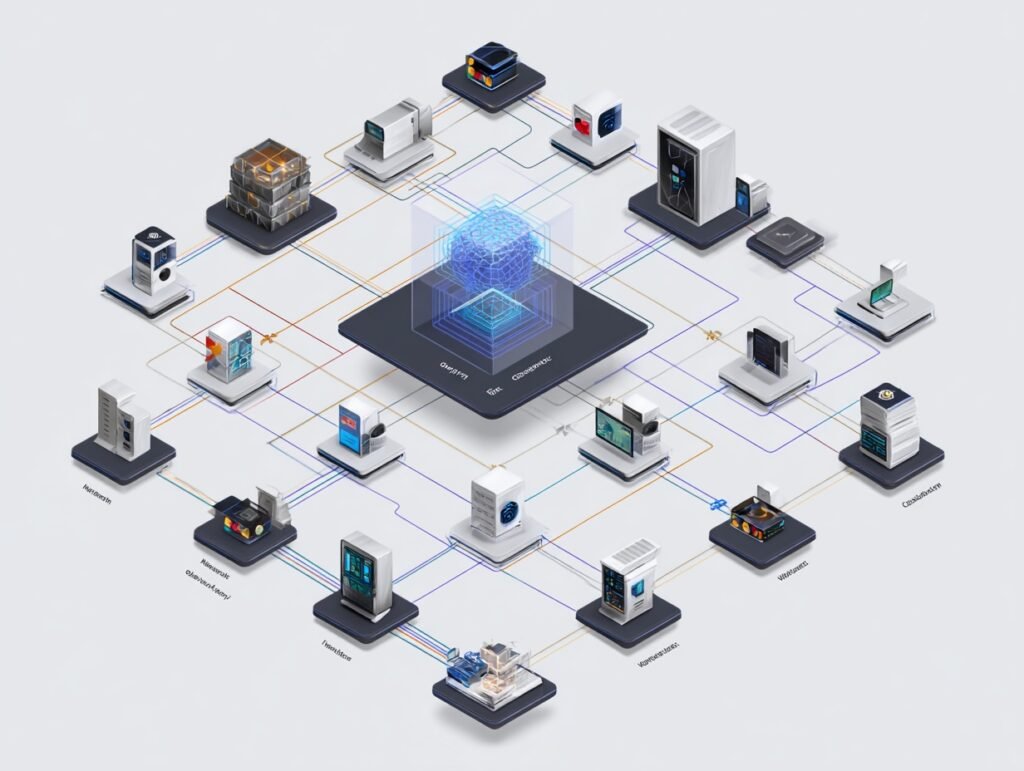

Building smarter systems starts with smarter foundations. Organizations across every industry are racing to harness AI for knowledge management. But without thoughtful planning, most of those systems underperform. AI knowledge base architecture is the structural framework that determines how information gets stored, organized, retrieved, and delivered to the right people at the right moment. Get it right, and your AI system becomes a genuine competitive advantage. Get it wrong, and you end up with a sophisticated tool that cannot find what people need. This post explores how to design a knowledge system that works, drawing on the latest research in retrieval-augmented generation, semantic search, and enterprise AI deployment.
Why AI Knowledge Base Architecture Matters Today
Every team deals with information overload. Documents pile up. Wikis go stale. Search returns the wrong results. Employees spend enormous amounts of time hunting for answers that should be easy to find. Research shows that employees spend roughly 19% of their workweek searching for and gathering information (Dewstack, 2025). That adds up fast and drains productivity in ways that are easy to underestimate.
The issue is structural: many organizations see knowledge management as mere storage, adding content without considering how it will be found. AI fundamentally improves this by understanding user intent and surfacing relevant answers, transforming static storage into active knowledge delivery.
A well-designed AI knowledge base architecture connects language models to organizational data in a way that is accurate, scalable, and easy to maintain. It is not just about having the right tools. It is about building the right foundation before those tools are ever deployed.
The Core Components of a Knowledge System
Three main components form the backbone of any AI knowledge system. The data layer is where raw content lives. This includes documents, databases, support tickets, and internal wikis. Before the AI can work with it, that content needs to be ingested, cleaned, and properly structured. Skipping this step is one of the most common and costly mistakes teams make early on.
The second component is the index. Embedding models transform your content into dense numerical vectors. Those vectors get stored in a vector database. When a user submits a query, the system identifies the vectors that are most semantically similar to the question. This is fundamentally different from keyword search, which looks only for exact word matches. Semantic search looks for meaning, not just terms.
The third component is the generation layer. This is where a large language model reads the retrieved content and formulates a response. The model does not generate freely from memory. It is generated based on what the retrieval system found. This approach anchors responses in real organizational data and significantly reduces the risk of AI hallucinations (“Retrieval-Augmented Generation to Generate Knowledge Assets,” 2025).
Retrieval-Augmented Generation as the Engine
Retrieval-augmented generation (RAG) is the core of most modern AI knowledge systems. The RAG process works in two steps. First, when a user submits a query, the system quickly scans the knowledge base and retrieves the most relevant documents. Second, a language model uses only this retrieved information—as opposed to all general knowledge it was trained on—to generate its response. This ensures that answers are based directly on up-to-date organizational data, making them both more accurate and specific to your context.
Separating retrieval from generation is a key strength of RAG. Instead of trying to store all possible organizational knowledge in the language model itself, RAG allows the knowledge base to be updated independently. The language model focuses on understanding user questions and formulating answers from the retrieved content. This structure keeps information easily up to date: changes to the knowledge base are instantly reflected in answers, without requiring retraining or adjusting the language model.
Enterprise adoption is accelerating. A 2025 systematic review of 63 high-quality studies found that 80.5% of enterprise implementations rely on standard retrieval frameworks, with GPT-based models powering the majority of deployments (“Retrieval-Augmented Generation and Large Language Models,” 2025). The research also flagged a significant gap between academic prototypes and production-ready systems, pointing to the need for more rigorous evaluation practices in real-world deployments.
RAG also supports auditability. Because every answer traces back to a retrieved document, you can show exactly where the information came from. That matters enormously in regulated industries and high-stakes decision environments where traceability is non-negotiable.
Building a Solid AI Knowledge Base Architecture
The most common mistake teams make when building an AI knowledge base architecture is treating the knowledge base as secondary. The focus goes to choosing the model, building the interface, and optimizing prompts. But the quality of the underlying data drives everything else.
If the knowledge base is disorganized or outdated, better models do not fix it; they just surface bad data more confidently, which is arguably worse.
Start by auditing your existing content. Identify what is accurate, what is outdated, and what needs to be removed entirely. Build a tagging system that captures source, topic, date, and access permissions. Good metadata dramatically improves retrieval precision and helps the system surface the right content at the right moment.
One emerging approach treats knowledge as a product in its own right. Specialized AI agents draw from both structured knowledge graphs and unstructured vector databases to serve different types of questions (Ben Abdallah, 2025). Deterministic agents handle formal logic and compliance rules. Language model agents handle open-ended queries. The combination produces more reliable and flexible results than a single-layer approach.
Chunking, Embedding, and Indexing Strategy
How you divide content into retrievable pieces is one of the most consequential decisions in knowledge base design. Most RAG systems split documents into chunks before indexing them. The size and logic behind those chunks shape retrieval quality in significant ways that are easy to overlook at the start of a project.
Splitting at fixed token counts often cuts sentences mid-thought. Semantic-aware chunking is more effective. Paragraph boundaries, section breaks, and natural topic shifts work as better dividers. The result is chunks that hold meaningful, self-contained units of information rather than fragments torn out of context.
Research into enterprise RAG deployments found that optimizing the knowledge base content itself, beyond just the model or the retriever, can significantly improve overall system performance (“Optimizing and Evaluating Enterprise RAG,” 2024). Simple improvements such as adding metadata, standardizing formatting, and cleaning raw text before indexing all compound into better retrieval outcomes over time.
Embedding models then convert each chunk into a vector. The choice of embedding model matters, especially for domain-specific language. A model fine-tuned for your subject area yields more accurate, contextually relevant retrieval results than a general-purpose alternative.
Governance, Evaluation, and the Road Ahead
A knowledge base is not a build-and-forget project. As information and policies change, new content must be regularly maintained; otherwise, even the best-designed system will become unreliable.
Assign content owners to different domains within the knowledge base. Build a review schedule into your workflow. Flag content that has not been validated recently. These practices may seem minor, but they protect the long-term reliability of the entire system and maintain user trust.
Evaluation is harder than it looks. Standard retrieval metrics, such as cosine similarity scores, are useful in controlled tests. But researchers building enterprise-scale RAG systems found that real-world performance requires a more human-centered approach, particularly for novel or complex user questions (“Optimizing and Evaluating Enterprise RAG,” 2024). Automated scores alone fail to capture whether answers are genuinely helpful in practice.
AI knowledge base architectures are evolving rapidly. Investing in robust, adaptable foundations now ensures organizations can adopt future advances without extensive rework. Thoughtful design today enables tomorrow’s AI capabilities to deliver real value.
Designing a powerful knowledge base is only part of the equation. See how technical writers are using AI to structure, scale, and maintain high-impact documentation: AI for Technical Writers.
References
Ben Abdallah, H. (2025, June 30). Architecture of the future — towards a knowledge-driven information system. Medium. https://medium.com/@helmi.confo/architecture-of-the-future-towards-a-knowledge-driven-information-system-knowledge-based-design-fda09f09352f
Dewstack. (2025, December 29). AI knowledge base — The complete guide to intelligent knowledge management in 2025. https://www.dewstack.com/blog/ai-knowledge-base-a-detailed-guide
Optimizing and evaluating enterprise retrieval-augmented generation — A content design perspective. (2024). In Proceedings of the 8th International Conference on Advances in Artificial Intelligence. Association for Computing Machinery. https://dl.acm.org/doi/10.1145/3704137.3704181
Retrieval-augmented generation and large language models for enterprise knowledge management and document automation — A systematic literature review. (2025). Applied Sciences, 16(1), 368. https://www.mdpi.com/2076-3417/16/1/368
Retrieval-augmented generation to generate knowledge assets and creation of action drivers. (2025). Applied Sciences, 15(11), 6247. https://www.mdpi.com/2076-3417/15/11/6247