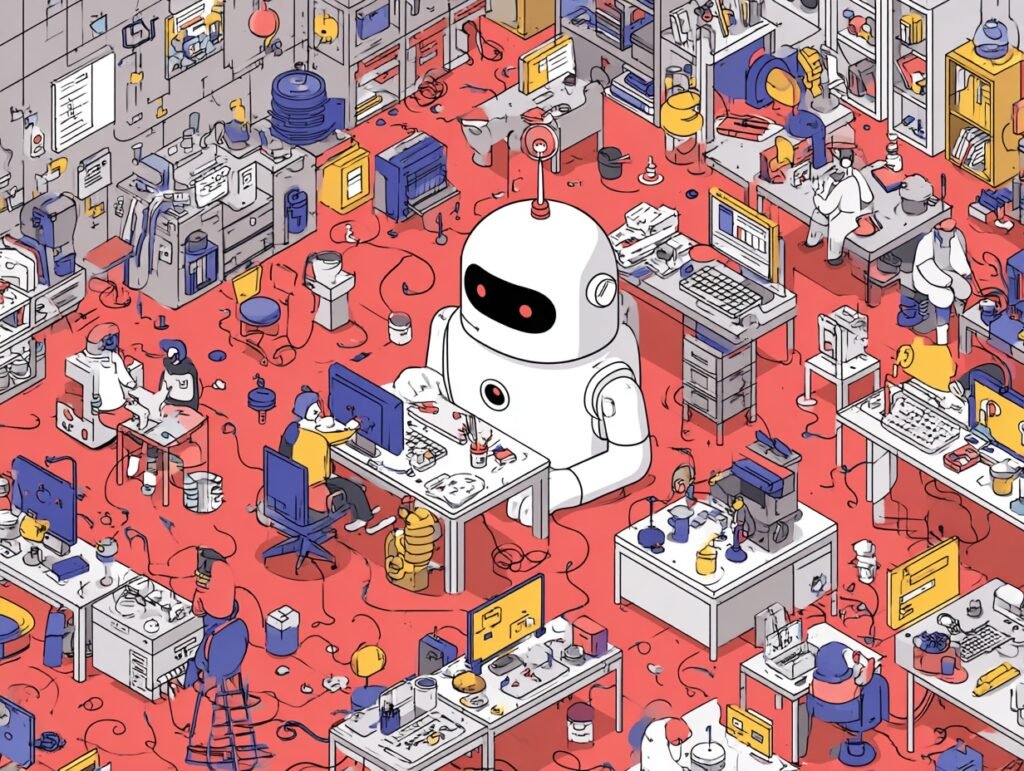

AI in tech jobs is no longer a distant concept. Instead, it defines the present moment. Across startups and global enterprises alike, its influence shows up in daily workflows. As a result, expectations shift quickly. At the same time, uncertainty spreads just as fast. On one side, some professionals worry about displacement. On the other side, many see an opportunity for growth. The reality, however, sits between those extremes.
AI in tech jobs is transforming how work gets done, yet it is also expanding what skilled professionals can achieve. Therefore, the more useful question is not whether AI belongs in technical careers. Rather, the better question is how each role adapts alongside it. To understand evolution clearly, we need to move step by step through the major tech disciplines and examine how responsibilities are changing in practice.
AI in Tech Jobs for Data Scientists
To begin with, data scientists have always worked closely with AI. Machine learning models, predictive analytics, and statistical experimentation formed the foundation of their role long before generative tools arrived. However, the rapid rise of large foundation models has accelerated change. Instead of building every model from scratch, many data scientists now fine-tune pre-trained models or integrate powerful APIs into existing pipelines. According to the 2026 AI Index Report, enterprise adoption of large models continues to expand across analytics teams (Stanford Institute for Human Centered AI, 2026). Consequently, workflows evolve.
For example, exploratory data analysis moves faster than before. AI assistants generate code suggestions. They recommend feature transformations. They summarize patterns in raw datasets. As a result, early-stage experimentation takes hours rather than days. Even so, human judgment remains central. Validation still requires careful review. Statistical assumptions still demand scrutiny. Business context still determines whether insights matter.
Moreover, the role itself expands beyond modeling. Increasingly, data scientists evaluate AI vendors, design system architectures, and advise executives on deployment strategy. Therefore, AI in tech jobs shifts data science from narrow analysis to broader decision-making. Technical depth remains essential. At the same time, communication and ethical reasoning become increasingly important. Ultimately, the strongest data scientists blend quantitative expertise with strategic thinking.
Technical Writers and AI in Tech Jobs
Next, consider technical writers. Few roles have felt such visible disruption. Generative tools now draft user guides, summarize APIs, and convert product notes into readable content within seconds. Because of that speed, some organizations question whether traditional documentation skills remain necessary. Yet evidence suggests the opposite. Research from the IBM Institute for Business Value indicates that companies using AI tools still identify quality assurance and clarity as major operational challenges in 2026 (IBM Institute for Business Value, 2026). Consequently, skilled writers remain essential.
In practice, AI often produces the first draft. Afterward, human professionals refine the structure, verify accuracy, and ensure alignment with the product itself. Furthermore, technical writers now design knowledge systems that support AI retrieval. Structured metadata enables chatbots to deliver correct answers. Logical taxonomies prevent confusion. Clear content models reduce the risk of hallucination.
As this shift unfolds, AI in tech jobs elevates technical writing to the level of knowledge architecture. Writers must understand how prompts influence output. They need to test model responses. They must recognize when AI fabricates details. In addition, collaboration with developers and product teams becomes more frequent. Therefore, the profession moves toward analytical oversight rather than simple content production. Ultimately, documentation becomes integrated into the AI-enabled product experience.
Software Developers Navigating AI in Tech Jobs
After that, software development offers another perspective. Coding assistants generate boilerplate functions. Automated refactoring appears inside development environments. Real-time vulnerability suggestions improve code quality. According to the 2026 Stack Overflow Developer Survey, most developers now regularly use AI tools in their workflows (Stack Overflow, 2026). As adoption increases, expectations evolve.
Nevertheless, core engineering principles remain critical. While AI can generate syntax, architecture decisions demand human experience. Scalability planning requires foresight. Secure system design depends on a deep understanding. For this reason, review processes become even more significant. Developers should guide AI output rather than compete with it.
Additionally, orchestration has become central. Modern systems integrate APIs, microservices, and AI components simultaneously. Developers must decide when AI enhances performance and when traditional logic provides stability. Consequently, AI in tech jobs reshapes developers into system orchestrators. Speed increases across the board. However, disciplined testing safeguards reliability.
As a result, technical fluency alone no longer guarantees success. Instead, developers who combine AI literacy with architectural vision deliver the greatest value. They move fluidly between rapid prototyping and long-term sustainability. In that sense, AI augments productivity while raising the bar for expertise.
Cybersecurity Professionals in an AI-Driven Environment
Meanwhile, cybersecurity professionals confront a parallel transformation. AI empowers attackers to automate phishing campaigns and generate malware variations. At the same time, defensive teams deploy AI for anomaly detection and predictive threat modeling. The World Economic Forum identifies AI-enabled cyber threats as a major global risk in 2026 (World Economic Forum, 2026). Consequently, the arms race intensifies.
Because of this dual-use dynamic, security teams must evaluate internal AI systems for vulnerabilities. Training data requires protection. Model outputs require monitoring. Beyond that, governance frameworks must account for regulatory compliance. Therefore, AI in tech jobs expands cybersecurity responsibilities rather than narrowing them.
Collaboration becomes essential. Developers coordinate secure coding practices. Executives consult on risk exposure. Employees receive training on AI-powered social engineering tactics. In addition, security professionals analyze AI model logs for signs of misuse. Thus, cybersecurity evolves into a predictive and preventive discipline.
Ultimately, expertise now spans both infrastructure security and AI architecture. Professionals who understand how models can be manipulated stand out. Through this lens, AI becomes both a threat vector and a defensive tool. The balance between those forces defines modern cybersecurity strategy.
Project Managers Coordinating AI in Tech Jobs
At this point, project managers enter the conversation. Because AI initiatives intersect multiple departments, coordination grows more complex. Data governance, infrastructure upgrades, ethical review processes, and employee training must align. According to McKinsey’s 2026 research, organizations that embed structured governance early capture greater productivity benefits from AI adoption (McKinsey Global Institute, 2026). Therefore, leadership in execution matters.
AI tools also support project managers directly. Meeting summaries are generated automatically. Risk analyses draw from historical data. Timeline adjustments appear dynamically. As a result, administrative burdens decrease. However, strategic oversight becomes more important.
Understanding AI fundamentals is now part of the job. Although coding expertise is unnecessary, awareness of feasibility and limitations is critical. Stakeholders rely on project managers to translate technical details into realistic plans. Consequently, AI in tech jobs reshapes project management into a strategic facilitation role.
Flexibility also becomes essential. AI capabilities evolve quickly. Scope may shift as tools improve. Therefore, experimentation frameworks help maintain alignment with business objectives. In this way, project managers bridge innovation and accountability.
Executive Leaders Guiding AI in Tech Jobs Strategy
Finally, executive leaders shape the overall direction. Budget decisions influence scale. Governance policies establish boundaries. Cultural messaging determines employee trust. Surveys show continued executive optimism regarding AI-driven growth through the end of the decade (IBM Institute for Business Value, 2026). Even so, optimism alone does not guarantee measurable success.
Structured implementation remains essential. Many organizations establish AI oversight committees. Clear ethical guidelines reduce uncertainty. Workforce development programs ensure employees across data science, software development, cybersecurity, technical writing, and project management adapt effectively.
Furthermore, communication plays a decisive role. Leaders must clarify what AI can and cannot accomplish. Transparency reduces fear. Alignment ensures investment supports long-term strategy rather than temporary trends. In addition, regulatory awareness shapes planning decisions. Monitoring global standards protects organizational stability.
Thus, AI in tech jobs at the executive level centers on balance. Innovation drives growth. Governance protects integrity. Leaders who integrate both perspectives set the tone for sustainable transformation.
The Continuing Evolution of AI in Tech Jobs
When viewed collectively, a consistent pattern appears. Across disciplines, AI amplifies capability while increasing responsibility. Data scientists design systems rather than isolated models. Technical writers architect knowledge structures. Developers orchestrate complex integrations. Cybersecurity professionals mitigate emerging AI-driven threats. Project managers coordinate cross-functional execution. Executive leaders define strategic direction.
Consequently, continuous learning becomes universal. Professionals experiment with tools. Teams refine processes. Organizations adapt governance frameworks. At the same time, human judgment remains indispensable. Context shapes decisions. Ethics guide implementation. Communication strengthens collaboration.
Therefore, engagement offers the most effective response. By learning how AI supports specific responsibilities, professionals strengthen their value. By understanding its limits, they protect quality and trust. In the end, AI in tech jobs represents partnership rather than replacement. Those who embrace that partnership will define the next era of technological innovation.
References
IBM Institute for Business Value. (2026). Global AI outlook 2026. https://www.ibm.com/thought-leadership/institute-business-value/report/global-ai-outlook-2026
McKinsey Global Institute. (2026). The state of AI in 2026. https://www.mckinsey.com/capabilities/quantumblack/our-insights/the-state-of-ai-2026
Stack Overflow. (2026). Stack Overflow developer survey 2026. https://survey.stackoverflow.co/2026/
Stanford Institute for Human Centered AI. (2026). AI Index report 2026. https://aiindex.stanford.edu/report/
World Economic Forum. (2026). Global Risks Report 2026. https://www.weforum.org/reports/global-risks-report-2026/