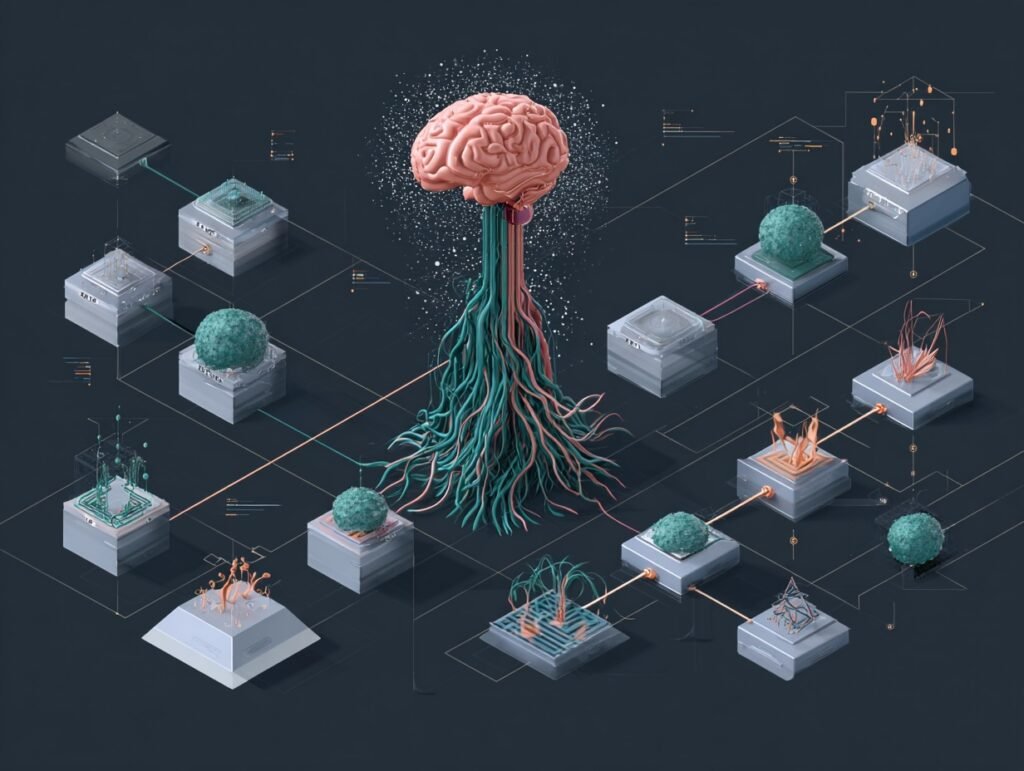

Building a great machine learning model takes more than choosing the right algorithm—the shape of your data matters just as much. AI feature engineering techniques address this. Previously, feature engineering was slow and manual, relying on domain expertise and intuition.
Today, however, things look very different. AI-powered approaches now automate much of that heavy lifting, making the process faster, more consistent, and often more effective. Whether you’re working with tabular data, raw text, images, or time series, the modern toolkit sharpens models and streamlines workflows. The payoff is well documented—models trained on well-engineered features consistently outperform those that skip this step (Zheng & Casari, 2018).
Why AI Feature Engineering Techniques Matter More Than You Think
There’s a classic saying in machine learning: garbage in, garbage out. It sounds straightforward. Nevertheless, the implications run surprisingly deep. Even the most sophisticated neural network will underperform with weak features. Similarly, a powerful gradient boosting model is only as good as the signal you feed it. Domingos (2012) argued that feature engineering is often more impactful than algorithm selection. That claim, moreover, still holds up today.
With AI-driven feature engineering, machine intelligence uncovers structures humans might miss, such as interaction terms or non-linear relationships. This yields a more expressive feature set, leading to better predictions, fewer errors, and more reliable generalization. To see how these advances play out in practice, let’s examine some of the main automated approaches in more detail.
Automated Feature Synthesis: Letting the Algorithm Do the Digging
Automated feature synthesis is one of the most exciting developments in this space. In essence, it uses algorithms to systematically generate new features from raw data. Here, a “feature” refers to an individual measurable property or characteristic in a dataset. Notably, it does this without requiring a human to specify each transformation manually. The most well-known framework for this is Deep Feature Synthesis (DFS). Kanter and Veeramachaneni (2015) introduced DFS to automate feature creation across relational datasets. In other words, it programmatically stacks and aggregates primitives—basic operations such as summing or counting—to ask thousands of data questions at once.
Tools like Featuretools have since made DFS widely accessible. As a result, practitioners at all levels can benefit. Furthermore, automated synthesis tends to surface features that a time-pressed analyst simply wouldn’t create manually. Beyond that, it makes the process repeatable. That repeatability, in turn, is especially valuable in production environments. Data schemas change frequently there, and pipelines need to stay robust over the long haul.
Representation Learning and Embeddings
Automated feature synthesis works well for structured data. Representation learning, on the other hand, tackles unstructured data — and that’s where deep learning has truly shone. The core idea is straightforward. Instead of hand-crafting features from text, images, or audio, you let a neural network learn compact representations on its own. Bengio et al. (2013) laid out a foundational framework that explained why these learned representations often outperform handcrafted ones. Specifically, they capture an abstract, hierarchical structure that manual features miss entirely.
Early examples, such as Word2Vec and GloVe, encoded semantic relationships between words in dense vector spaces. Since then, however, the field has moved much further. Transformer-based models like BERT and GPT now produce contextual embeddings that are far richer. Moreover, they capture how word meaning shifts depending on context. For practitioners, this is a major advantage. You can take a pretrained embedding model off the shelf and use it as a feature extractor. Even better, this works well even when labeled training data is scarce.
AI Feature Engineering Techniques for High-Dimensional Data
High-dimensional data is one of the trickiest challenges in machine learning. Consider a dataset with hundreds or thousands of raw features — such as genomic data, sensor readings, or user behavior logs. In those cases, you quickly run into what’s called the curse of dimensionality. More features don’t automatically mean more signal. Instead, they often introduce more noise, more overfitting risk, and longer training times. Fortunately, AI feature engineering techniques address this directly through dimensionality reduction. These methods compress information into a smaller, more manageable space. Principal Component Analysis (PCA) has handled this job for decades. However, newer approaches like autoencoders and variational autoencoders go further. Specifically, they learn non-linear compressions that PCA simply can’t achieve. These learned representations also tend to preserve the structure most relevant to downstream tasks. Additionally, Heaton (2016) found empirically that thoughtful feature engineering — including dimensionality reduction — reliably improved model performance across multiple benchmark datasets. With slimmer, higher-quality features in place, the next step is deciding which ones are truly essential for your models.ts.
AI Feature Engineering Techniques: Feature Selection
Even after engineering a rich feature set, not every feature earns its place. Feature selection is the process of identifying which features add signal and which only add noise. There are three broad approaches worth knowing. First, filter methods rank features based on statistical properties, independent of any model. Second, wrapper methods evaluate feature subsets by training and testing a model on each. Third, embedded methods perform selection during training itself — LASSO regularization and tree-based importance scores are common examples. In practice, though, many teams blend these approaches together. For instance, a quick filter pass can eliminate low-variance or highly correlated features upfront. After that, an embedded method handles finer-grained selection. Additionally, AutoML platforms are increasingly folding feature selection into their broader pipelines. As a result, the whole process runs as part of a larger search over models and hyperparameters. Ultimately, you can start with a bloated feature set and come out with something lean and effective. Now, let’s see how all these steps fit together in one streamlined pipeline.ve.
Putting Your Feature Engineering Pipeline Together
Bringing everything together into one coherent pipeline is where theory finally meets practice. It’s also notably where many teams hit friction. A solid AI-driven pipeline generally starts with data profiling. That means understanding distributions, missing values, and cardinality before anything else. Next, transformation steps kick in — encoding categorical variables, handling datetime features, and normalizing numeric ranges. Each step, in turn, prepares the data for what comes after.
From there, automated synthesis or representation learning adds new features to the mix. Subsequently, dimensionality reduction reduces the set. Finally, feature selection handles the last round of curation. Throughout this process, it helps to stay anchored to your end goal. The aim isn’t the most features or the cleverest transformations. Rather, it’s the feature set that best serves your model’s specific task. Zheng and Casari (2018) noted that good feature engineering requires understanding the problem domain just as much as technical skill. That combination — domain intuition amplified by AI feature engineering techniques — is ultimately what separates models that look good in notebooks from those that genuinely perform in the real world.
This post is part of our complete guide to AI for Data Scientists. Head there to explore the full picture.
References
Bengio, Y., Courville, A., & Vincent, P. (2013). Representation learning: A review and new perspectives. IEEE Transactions on Pattern Analysis and Machine Intelligence, 35(8), 1798–1828. https://doi.org/10.1109/TPAMI.2013.50
Domingos, P. (2012). A few useful things to know about machine learning. Communications of the ACM, 55(10), 78–87. https://doi.org/10.1145/2347736.2347755
Heaton, J. (2016). An empirical analysis of feature engineering for predictive modeling. 2016 IEEE SoutheastCon, 1–6. https://doi.org/10.1109/SECON.2016.7506650
Kanter, J. M., & Veeramachaneni, K. (2015). Deep feature synthesis: Towards automating data science endeavors. 2015 IEEE International Conference on Data Science and Advanced Analytics (DSAA), 1–10. https://doi.org/10.1109/DSAA.2015.7344858
Zheng, A., & Casari, A. (2018). Feature engineering for machine learning: Principles and techniques for data scientists. O’Reilly Media. https://www.oreilly.com/library/view/feature-engineering-for/9781491953235/