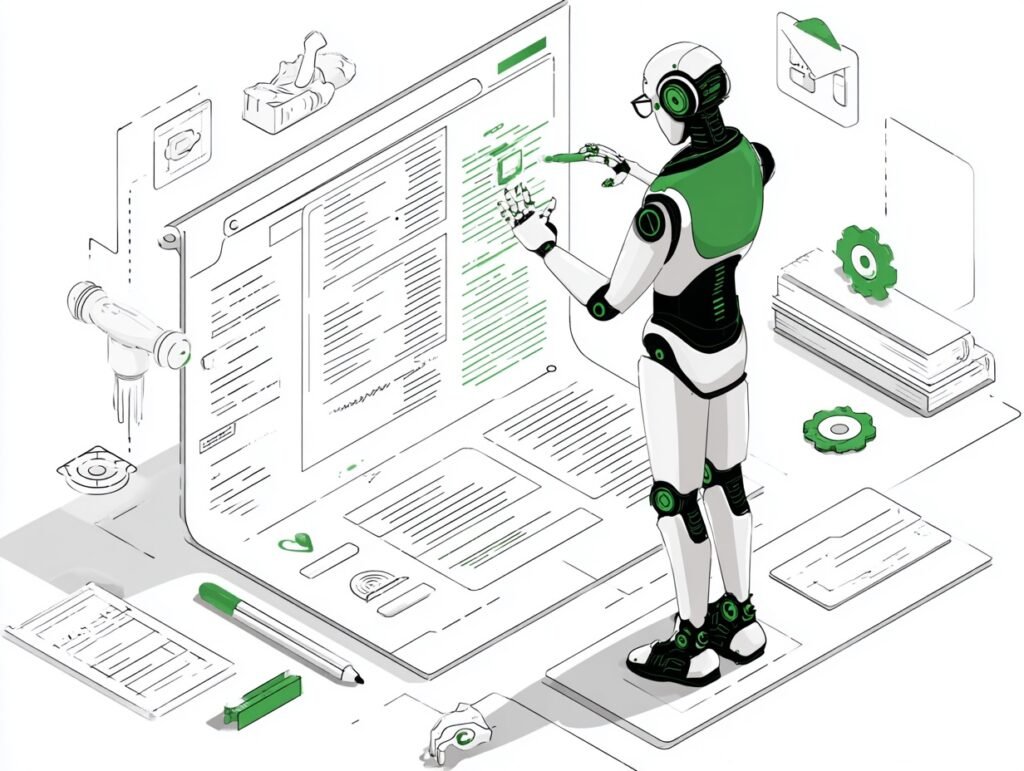

If you have spent any time managing technical documentation, you already know how fast things go sideways. One product update sneaks through, and suddenly three different pages contradict each other. So when AI documentation tools started promising to fix all of that, plenty of teams jumped in. Solid AI documentation automation strategies can solve a lot of those problems, but only if you set them up with accuracy in mind.
The results have been mixed. The speed gains are real. Accuracy takes more intentional work. The good news is that AI documentation automation strategies do not have to come at the expense of getting things right. With the right approach, you can move faster and still keep your docs trustworthy. This post walks through practical strategies that help, whether you are getting started or cleaning up a process that is already in motion.
Why AI Documentation Automation Strategies Deserve More Attention
Most teams start using AI for documentation because they are overwhelmed. There is too much to write, too little time, and not enough writers. That is a reasonable place to be.
Still, jumping straight into automation without a plan creates a new kind of problem. You get content that sounds polished, but gets details wrong. At the same time, leadership pressure is shifting. In its Document automation trends 2026 report, Rossum frames the current phase as moving past experimentation and into a mandate where teams are expected to show measurable returns, not just produce more output (Rossum, 2025).
So the question is not whether to use AI. That decision is already made in many organizations. The real question is how to use it in a way that keeps accuracy front and center.
The Accuracy Problem With Automated Documentation
Before you fix accuracy, it helps to name where it breaks. First, there is hallucination. Language models can generate statements that sound plausible but are false, even when the prompt looks straightforward (OpenAI, 2025). That is risky in docs where precision matters, like API references, error codes, and procedures.
Second, there is staleness. A model will not automatically know what changed last Tuesday unless your workflow pulls in current, authoritative sources at generation time. Third, there is inconsistency. When different people prompt in different ways, you can end up with uneven tone, shifting terminology, and mismatched structure.
It also helps to be honest about evaluation results. Even when you measure hallucination rate directly, it can vary by task and setup. For example, OpenAI’s system card for o3 and o4-mini describes how they evaluate hallucinations across benchmarks (OpenAI, 2025a). Accuracy is not a single number you assume. It is something you design for.
Building Reliable Inputs for Better AI Outputs
One of the most underrated AI documentation automation strategies is investing in your source content before you ever prompt the model.
Your AI tool will take what you give it and run with it. So if your source material is disorganized, outdated, or ambiguous, the output will reflect that.
A structured content library that acts as a single source of truth makes a major difference. Prompt templates reduce variation. Retrieval-based workflows keep drafts grounded in approved content instead of drifting into generic output (Responsive, 2025).
Setting Up Human Review That Actually Scales
A lot of teams save time drafting with AI, then lose those savings by routing every output through the same heavy manual review.
The fix is a tiered review system tied to risk. Low-risk content gets a light pass. High-risk content gets deeper scrutiny. Kapoor (2026) describes how QA teams combine test sets, validation checks, and human review to catch confidently wrong AI outputs at scale.
For documentation teams, the principle is similar. Tag content types. Assign review tiers. Feed corrections back into prompts and source libraries.
Version Control and Change Management That Keeps Docs Current
Automation without change management creates outdated documentation.
Connecting documentation workflows to release processes allows your system to flag impacted sections when a product update occurs. Document360 highlights the shift toward real-time synchronization and governance workflows that reduce outdated information reaching users (Murugesan, 2025).
Metadata tagging and ownership assignment help maintain alignment over time.
Measuring and Maintaining Documentation Quality Over Time
Getting your AI documentation automation strategies set up well is a start. Keeping them working requires monitoring.
Track:
- Error rates from user feedback
- AI draft pass rates
- Documentation update frequency relative to product releases
Add periodic SME spot audits. Revisit prompts and source libraries quarterly. Accuracy is not a one-time configuration. It is an ongoing discipline.
Want ready-to-use prompts for documentation work?
If you liked these AI documentation automation strategies, grab my lead magnet, 10 AI Prompts for Technical Writers. It’s built to help you move faster while keeping accuracy front and center.
Get the 10 AI Prompts Lead MagnetWant the full technical writing playbook?
This post covers documentation automation strategies. If you want the bigger picture, including workflows, tools, and real-world examples, jump to the full guide on my pillar page.
Read the Technical Writing Pillar GuideReferences
Kapoor, P. (2026, January 23). AI hallucination testing in 2026: How QA engineers detect confidently wrong AI answers. Medium.
https://medium.com/ai-in-quality-assurance/ai-hallucination-testing-in-2026-how-qa-engineers-detect-confidently-wrong-ai-answers-cb978ec6cc26
Murugesan, S. (2025, December 23). AI documentation trends every team must prepare for in 2026. Document360.
https://document360.com/blog/ai-documentation-trends/
OpenAI. (2025, September 5). Why language models hallucinate.
https://openai.com/index/why-language-models-hallucinate/
OpenAI. (2025, April 16). OpenAI o3 and o4-mini system card.
https://cdn.openai.com/pdf/2221c875-02dc-4789-800b-e7758f3722c1/o3-and-o4-mini-system-card.pdf
Responsive. (2025, December 8). Understanding AI proposal automation software in 2026.
https://www.responsive.io/glossary/ai/understanding-ai-proposal-automation-software-in-2026
Rossum. (2025). Document automation trends 2026: From hype to high returns.
https://rossum.ai/wp-content/uploads/2025/11/dat_26_report-3.pdf