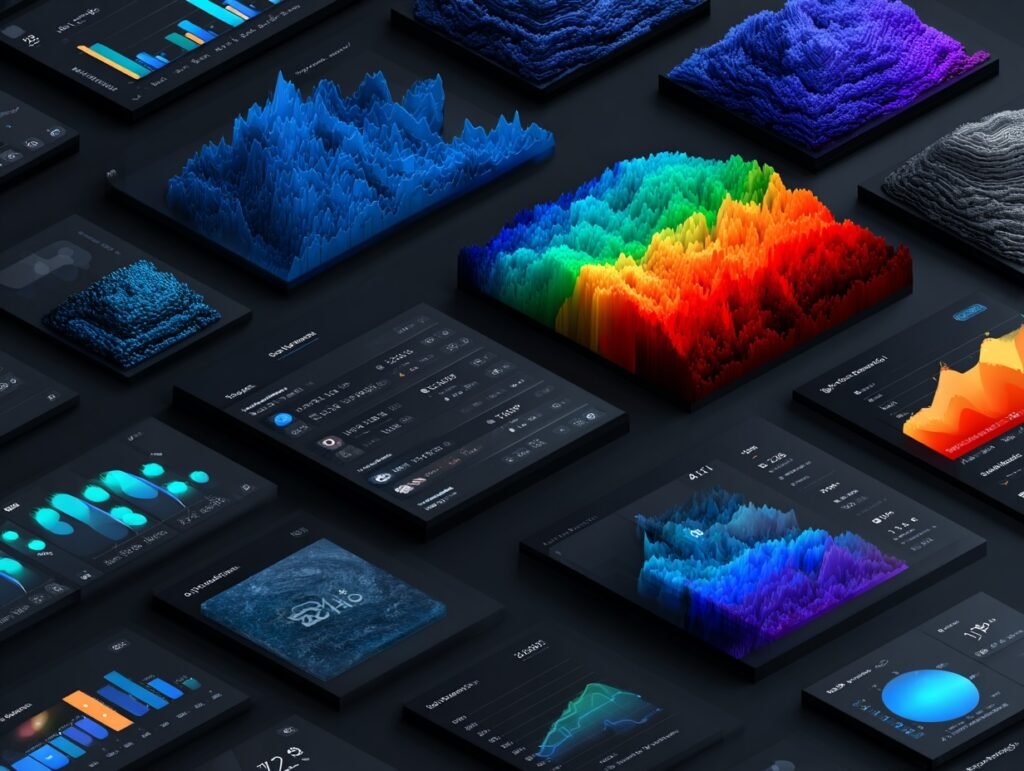

Organizations face daunting challenges in making sense of ever-growing data volumes. AI data visualization tools fundamentally transform analytics by automatically turning raw, complex data into clear visuals—dramatically reducing manual work and accelerating access to insights. This shift frees teams to focus on strategy rather than routine chart-building. Automation in visualization marks a core transition in how businesses operate with data. Knowing these techniques is essential for staying competitive in a data-driven world.
What Makes AI Data Visualization Tools So Powerful
Traditional data visualization required significant technical skill. Analysts manually cleaned datasets, chose chart types, and built dashboards from scratch. Today, AI-powered platforms handle most steps automatically, resulting in a faster, more accurate, and accessible analytics workflow. According to Narkhede (2025), AI-powered visualization delivers insights 73% faster and saves analysts over 8 hours weekly. This efficiency benefits any team. These tools also identify patterns and anomalies a human might overlook, delivering richer, reliable insights without deep technical expertise. The democratization of data is a transformative aspect of modern visualization, accelerating as AI capabilities evolve.
Besides speed, these tools make visualizations more consistent. People make different choices from day to day. AI systems, however, use the same approach every time. This means AI dashboards are not only faster but also higher quality. Also, as organizations grow, being able to automate visualization is very important. One AI platform can help many departments simultaneously, enabling company-wide data literacy.
How Automated Data Preparation Changes the Game
Before any chart appears, data must be prepared. Traditionally, this consumed up to 80% of an analyst’s time. AI changes that. Machine learning algorithms automatically collect data from multiple sources, identify and correct issues such as missing values or duplicates, and normalize data structures. This process, called data integration (Appinventiv, 2025), eliminates much manual work. Analysts receive clean, unified data, ready for visualization almost instantly, with fewer errors. As a result, visualizations are more accurate and trustworthy than those generated through traditional manual pipelines.
AI Data Visualization Tools and Natural Language Processing
Natural language processing (NLP) is a recent development in this field. With NLP, users interact with data in everyday language rather than technical commands. Instead of complex queries, a user can simply ask, “What were total sales by region last quarter?” The AI interprets the request, queries the data, and generates a relevant visualization. This allows non-technical users, such as marketing managers, to explore data independently. According to Julius AI (2025), natural language interfaces democratize data access across organizations.
NLP tools can also keep track of the conversation. This lets users ask follow-up questions and dig deeper into the data. This makes exploring data smooth and easy, not a technical hassle. Recent advances in large language models have also made these tools better at understanding tricky or unclear questions. This means the gap between what the user wants and what the tool shows has narrowed significantly, making NLP one of the most important automation methods today.
Intelligent Chart Selection and Visual Recommendations
Picking the right chart can be hard—a poor choice can hide useful information. AI helps by using smart suggestion systems that analyze data, variables, and relationships. The system then selects the best chart type, such as a bar chart, scatter plot, heat map, or interactive dashboard (Ye et al., 2024). Some platforms use more rules to consider the audience and goal. This way, each chart aligns with its purpose and context, reducing guesswork.
Predictive Analytics and Real-Time Dashboard Automation
AI data visualization tools now forecast the future with predictive analytics—a powerful automation technique. These tools use machine learning to identify trends and forecast them. Businesses in finance, healthcare, and retail use these capabilities to anticipate demand, detect fraud, and optimize supply chains. For example, a retailer used AI-powered visualization to analyze weather, events, and purchasing trends, increasing inventory turnover by 34% and reducing stockouts by 41% (Narkhede, 2025). This makes predictive visualization a business priority.
Real-time dashboard automation ensures insights remain up to date. Instead of waiting for weekly reports, decision-makers view live streams that refresh automatically. This is especially valuable in fast-paced environments like e-commerce and financial trading. Anomaly detection in dashboards alerts teams instantly to unusual data, enabling immediate response to problems or opportunities—rather than discovering them later in static reports.
Generative AI and the Evolution of Visual Storytelling
Generative AI takes data visualization to a new level. Instead of fixed templates, generative models produce visuals that fit different audiences and uses. Ye et al. (2024) explain that generative tools, including large language and diffusion models, work at four stages: data enhancement, visual mapping, stylization, and interaction design. This is a big step beyond regular dashboard software. Generative AI can make story summaries with charts. For example, a tool might analyze sales data, spot a revenue surge, and write an explanation with the chart in seconds. This makes data stories richer and easier for everyone to understand.
Research in this area is growing quickly. A 2025 review in Frontiers of Communication looked at 127 studies on data visualization in AI-supported decision-making. It found that interactivity, ease of use, and reducing user thinking are key design needs (Frontiers of Communication, 2025). Generative AI helps with all three. It makes visuals that are interactive, easy to use, and designed to help users understand data with less effort.
Choosing the Right AI Data Visualization Tools for Your Strategy
Selecting the right AI data visualization platform is critical to effectively leveraging data. Focus on natural language capabilities, real-time integration, and predictive analytics features when evaluating options. Ensure the tool aligns with your existing infrastructure and security standards. Defining clear criteria simplifies selection and ensures a strong alignment with business needs.
It is also worth noting that adoption strategy matters just as much as tool selection. Even the most sophisticated AI visualization platform will fail to deliver value if teams are not trained to use it effectively. Therefore, pairing the right tool with a thoughtful onboarding program is essential. Furthermore, starting with one high-impact use case and expanding from there tends to drive better long-term results than attempting a sweeping enterprise-wide rollout all at once. A phased approach builds confidence, surfaces real-world feedback, and demonstrates measurable return on investment along the way.
The Road Ahead for AI-Powered Visualization
The evolution of AI data visualization automation is far from finished. In fact, it is just gaining momentum. Emerging capabilities include multimodal analysis, where AI systems process text, voice, images, and structured data simultaneously to produce unified visual outputs. Additionally, agentic AI systems, which operate semi-autonomously to pursue defined analytical goals, are beginning to appear in leading platforms. These systems do not simply respond to user queries. Instead, they proactively surface insights, flag anomalies, and generate updated visualizations without being prompted. As a result, organizations will increasingly move from reactive analytics to always-on intelligence that operates continuously in the background. According to broader industry analysis, enterprise adoption of AI data tools is growing at a compound annual rate of nearly 28%, with the market projected to reach over $ 826 billion by 2030 (Narkhede, 2025). That trajectory underscores just how transformational this technology is becoming across the global economy.
AI data visualization automation is no longer a futuristic concept reserved for large enterprises with massive technology budgets. It is a practical, proven set of techniques that organizations of every size are adopting right now. From automated data preparation to NLP querying, intelligent chart selection, real-time dashboard automation, and generative visual storytelling, every stage of the visualization pipeline is being reshaped by AI. Furthermore, these advances are making data genuinely accessible to people who were previously locked out by technical barriers. As a result, better decisions are being made faster than ever before. The organizations that embrace these tools and techniques today will be far better positioned to thrive in an increasingly data-rich and competitive future.
If AI is changing how you work with data, you will not want to miss what it is doing for data scientists right now.
References
Appinventiv. (2025). AI-powered data visualization: Unlock dynamic insights in 2025. https://appinventiv.com/blog/ai-in-data-visualization/
Frontiers of Communication. (2025). Data visualization in AI-assisted decision-making: A systematic review. Frontiers of Communication, 10. https://doi.org/10.3389/fcomm.2025.1605655
Julius AI. (2025). Top 7 AI data visualization tools for 2025. https://julius.ai/articles/top-7-ai-data-visualization-tools-for-2025
Narkhede, H. (2025, October 16). AI data visualization tools: Complete 2025 guide & top 10. SR Analytics. https://sranalytics.io/blog/ai-data-visualization-tools/
Ye, Y., Ying, H., Zhang, W., Zhou, Z., Zhao, Y., Xu, W., & Chen, W. (2024). Generative AI for visualization: State of the art and future directions. arXiv. https://arxiv.org/abs/2404.18144