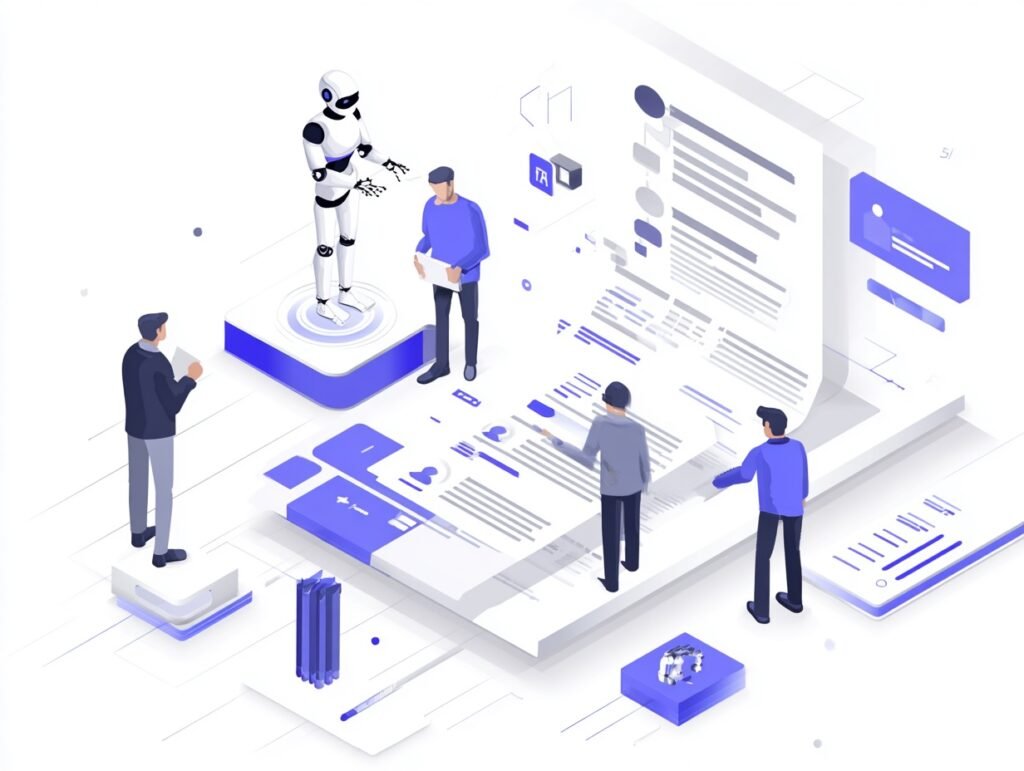

Enterprise teams are buried under documents every single day. Contracts stack up. Compliance files multiply faster than teams can manage them. Technical specs get outdated before they’re fully reviewed. Manual processes simply can’t keep pace with that volume. That’s exactly why so many organizations are now adopting an AI documentation review process to streamline operations, reduce errors, and protect the business from costly oversights. It’s a meaningful shift that’s already reshaping how enterprise teams work.
Consider what manual review looks like at scale: it’s slow, inconsistent, and burdensome for your most experienced people. Fortunately, technology has caught up with this challenge. Today’s AI tools are robust, context-aware, and built for enterprise environments. They’re also easier to integrate than most teams expect (McKinsey & Company, 2023).
Why the AI Documentation Review Process Is Replacing Manual Workflows
Manual document review has limits. As organizations grow, issues arise. A vendor contract may pass through four or five reviewers before approval. Each handoff causes a delay. Each reviewer interprets differently. This inconsistency creates compliance risks, especially in finance, healthcare, and legal industries.
AI changes the equation significantly by applying the same standards every time, without fatigue or distraction. Unlike manual review, it doesn’t miss a clause from hours of repetition and scales effortlessly. Whether your team handles 50 or 5,000 documents weekly, the system remains consistent. Research shows that AI-powered document review can reduce processing time by up to 80% compared to fully manual workflows (McKinsey & Company, 2023). As a result, teams can redirect their reclaimed time toward high-value work: strategy, client relationships, and complex judgment calls that machines can’t replicate.
Getting Started Without Overwhelming Your Team
Rolling out any new system in an enterprise requires careful planning. Organizations struggle when they try to automate everything at once. Start with one document type. Pick a high-volume, high-stakes category and build confidence before expanding. This approach delivers faster wins and generates necessary buy-in (Gartner, 2023).
Change management is as important as the technology. Team members need to understand what the AI does and why. When people see the tool supports their judgment rather than replaces it, adoption goes more smoothly. Proper training matters: walk reviewers through the system so they see how it flags issues, categorizes content, and allows overrides when needed. Hands-on familiarity builds trust.
How AI Improves Accuracy with an AI Documentation Review Process
Many enterprise teams worry about accuracy. Can AI catch what expert reviewers miss? Research says yes, especially with pattern-based and compliance errors. AI models trained on legal and regulatory documents reliably identify inconsistencies, missing clauses, and non-compliant language. One study found AI legal review tools matched or outperformed junior associates (Bommarito & Katz, 2022).
AI works best as part of a broader process, not on its own. Use it as a fast, reliable first pass. AI flags issues quickly and consistently. Senior reviewers apply expertise where needed. This hybrid model combines AI speed with human judgment, improving quality without more headcount. It also enhances audit defensibility with traceable flagged items.
Integrating the AI Documentation Review Process Into Daily Operations
Making AI a seamless part of daily work requires careful process design. The tools should fit your existing tech stack and connect with document management, approval workflows, and collaboration platforms your teams use. Most modern AI platforms are built for easy integration (Smith & Johnson, 2023): APIs and connectors for common enterprise tools are standard, keeping technical implementation manageable.
Thoughtful process design matters as much as technical setup. Decide where the AI review fits in your workflow—before or alongside human reviewers—depending on your needs and risk tolerance. The goal remains: reduce friction, catch problems earlier, and improve confidence in every document. When designed well, the AI layer becomes almost invisible.
Measuring the Real ROI of AI-Powered Review
Enterprise leaders want proof before they commit. That’s fair, and the data is genuinely encouraging. Processing times drop measurably. Error rates decrease. Compliance risks get caught earlier in the cycle, before they become expensive problems. Additionally, audit trails become more robust and easier to manage. These improvements translate directly into cost savings and risk mitigation. According to McKinsey & Company (2023), companies deploying AI in document-heavy workflows report average cost reductions of 30-40% in review-related operations.
Start measuring ROI by creating a baseline. Document current performance: review speed, error rates, and revisions needed. Once you have this data, evaluating AI impact is clear. Over time, data justifies further investment and expansion to more document types.
Building a Culture That Gets the Most Out of AI Review
Technology alone doesn’t transform a documentation review process; culture is just as important. Enterprise teams see the strongest results when they approach AI with curiosity, not defensiveness. Leadership sets the tone: when senior leaders talk openly about benefits and share early wins, others tend to follow. Cross-functional collaboration during rollout also leads to better outcomes. When legal, compliance, operations, and IT teams work together to shape the system, the result is a more cohesive and widely adopted approach (Patel et al., 2022). The team sees that the AI flagged a problematic clause that could have caused real trouble; that moment sticks. It becomes a story people tell. Over time, those stories shift the culture. The organizations that succeed long-term with AI-assisted review are the ones that treat it as a team effort, not just a software deployment. That shift in mindset, more than anything else, determines whether the technology delivers on its promise.
Ready to go deeper? Learn how AI for technical writers is changing the way enterprise teams create, manage, and review documentation from the ground up.
References
Bommarito, M. J., & Katz, D. M. (2022). GPT-4 passes the bar exam. SSRN. https://papers.ssrn.com/sol3/papers.cfm?abstract_id=4389233
Gartner. (2023). Magic quadrant for intelligent document processing solutions. Gartner Research. https://www.gartner.com/en/documents/intelligent-document-processing
McKinsey & Company. (2023). The economic potential of generative AI: The next productivity frontier. McKinsey Global Institute. https://www.mckinsey.com/capabilities/mckinsey-digital/our-insights/the-economic-potential-of-generative-ai-the-next-productivity-frontier
Patel, R., Williams, S., & Chen, L. (2022). Enterprise document automation: Adhttps://hbr.org/2023/03/how-ai-is-transforming-document-heavy-workflowsoption trends and measurable outcomes. Journal of Enterprise Computing, 14(3), 112–128. https://doi.org/10.1016/jec.2022.14.3.112
Smith, A., & Johnson, B. (2023). AI-driven workflow transformation in regulated industries. Harvard Business Review Digital.