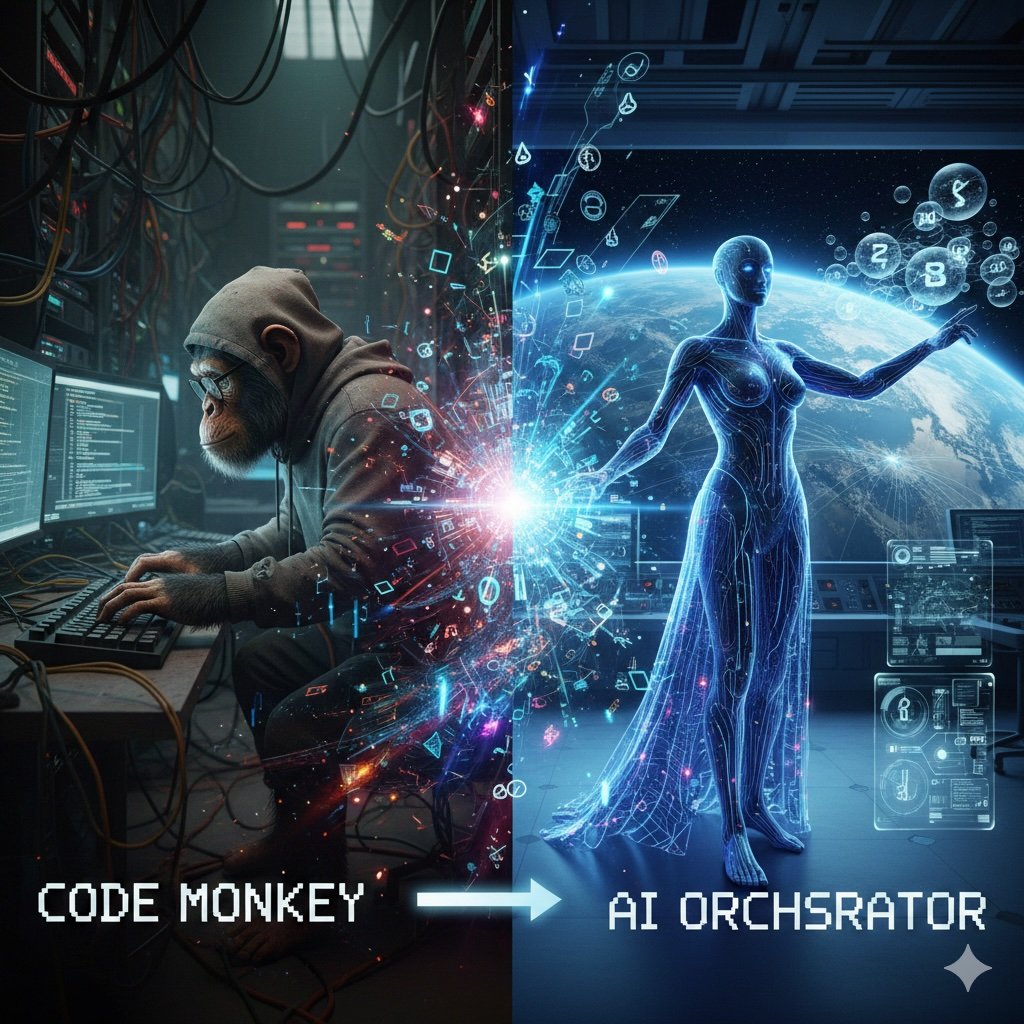

If you have been writing software for any length of time, you have almost certainly felt a quiet shift in the air over the past couple of years. The tools changed first, then the job postings changed, and now the conversations in team meetings are starting to change, too. The question is no longer whether AI will reshape software development careers. It already has. What this post is going to dig into is how developers become AI orchestrators and how you position yourself on the right side of that transition.
What AI Is Doing to Developer Workflows Right Now
GitHub’s research on Copilot found that developers using AI coding assistants completed tasks up to 55 percent faster than those working without them (Peng et al., 2023). That number points to something concrete. A large portion of what fills a developer’s day, writing boilerplate, generating repetitive patterns, scaffolding basic functions, can now be delegated to an AI tool with a well-constructed prompt.
Faster task completion does not mean fewer developers, though. It shifts demand upward. When mechanical coding gets cheaper and faster, the value of the human contribution concentrates in the parts AI cannot replicate: understanding ambiguous requirements, making architectural decisions, and catching the errors a code generator confidently produces without knowing anything went wrong. McKinsey frames this as task displacement rather than job displacement (McKinsey Global Institute, 2023). The tasks change before the jobs do.
How Developers Become AI Orchestrators: What the Role Looks Like in Practice
Orchestration means directing multiple systems toward a coherent outcome. It means knowing which tool to reach for, evaluating output critically, chaining AI capabilities together, and holding the whole system accountable to real-world requirements.
On a given Tuesday, an orchestrator describes a function’s requirements precisely, reviews the AI-generated draft for correctness and edge cases, refines the prompt when the output misses something, and integrates the result into a larger system. The code gets written faster, but the judgment involved in directing, reviewing, and integrating it stays entirely human. That distinction matters more than most people realize.
The Skills Gaining Value Right Now
Prompt engineering has moved from novelty to genuine professional competency. White et al. (2023) demonstrated that structured prompting produces significantly more reliable outputs than ad hoc requests, and the skill transfers across tools and domains. For developers, communicating precisely with AI systems is a technical skill with measurable effects on output quality.
Systems thinking has also become more valuable than ever. When individual coding tasks can be offloaded, the premium on understanding how systems fit together and how failure propagates across an architecture increases considerably. Beyond that, evaluation skills are becoming critical. AI-generated code looks correct far more often than it is correct. Learning to read generated output with appropriate skepticism, and to construct tests that reveal hidden assumptions, takes time to develop and will increasingly separate strong developers from weak ones.
How Developers Become AI Orchestrators: Three Stages Worth Thinking Through
The first stage is augmentation. This is where most developers are right now. You incorporate AI tools into an existing workflow to do what you already do more efficiently. The role stays the same. The tooling changes. This stage is valuable, but it is also the most competitive ground because it requires the least differentiation.
The second stage is elevation. Rather than using AI to do existing tasks faster, elevation means taking on work that was previously out of reach due to bandwidth constraints. Architects who can now prototype faster. Technical leads who can produce proof-of-concept implementations in hours rather than days. At this stage, AI expands the scope of what you can deliver as an individual contributor.
The third stage is orchestration in the fullest sense. This involves designing and managing systems where AI agents handle significant portions of implementation work, with a human overseeing quality, coherence, and alignment with real-world goals. The Stack Overflow Developer Survey found that a growing share of developers already describe their role as directing and reviewing AI-generated work rather than writing primary code themselves (Stack Overflow, 2024). This is where the career leverage concentrates.
What to Do Starting This Week
The most practical starting point is deliberate experimentation with the tools you already have. Push them into territory where they struggle. Observe where and how they fail. Build a personal mental model of their limitations. That understanding separates a developer who uses AI from one who can direct it effectively.
From there, shift your attention toward the parts of your work that AI cannot touch. The conversations where you translate business needs into technical decisions. The architectural reviews where competing approaches need evaluation against constraints that nobody wrote down. The moments where something feels wrong in a system and you have to reason backward from a symptom to a cause. Those moments define your value as AI handles more of the implementation layer.
The Bigger Picture
The developers who approach this transition with curiosity rather than anxiety, who invest in understanding the tools deeply, and who think carefully about where their judgment adds the most value, are the ones building careers that will look stronger in five years than they do today. The evolution from code monkey to AI orchestrator is not a loss of identity. It is a genuine upgrade in the kind of work you get to do and the kind of problems you get to solve.
Want to ship faster without sacrificing quality? Read AI for Software Developers: A Complete 2026 Career Guide
References
McKinsey Global Institute. (2023). The economic potential of generative AI: The next productivity frontier. McKinsey & Company. https://www.mckinsey.com/capabilities/mckinsey-digital/our-insights/the-economic-potential-of-generative-ai-the-next-productivity-frontier
Peng, S., Kalliamvakou, E., Cihon, P., & Demirer, M. (2023). The impact of AI on developer productivity: Evidence from GitHub Copilot. arXiv. https://doi.org/10.48550/arXiv.2302.06590
Stack Overflow. (2024). Stack Overflow developer survey 2024. Stack Overflow. https://survey.stackoverflow.co/2024/
White, J., Fu, Q., Hays, S., Sandborn, M., Olea, C., Gilbert, H., Elnashar, A., Spencer-Smith, J., & Schmidt, D. C. (2023). A prompt pattern catalog to enhance prompt engineering with ChatGPT. arXiv. https://arxiv.org/abs/2302.11382