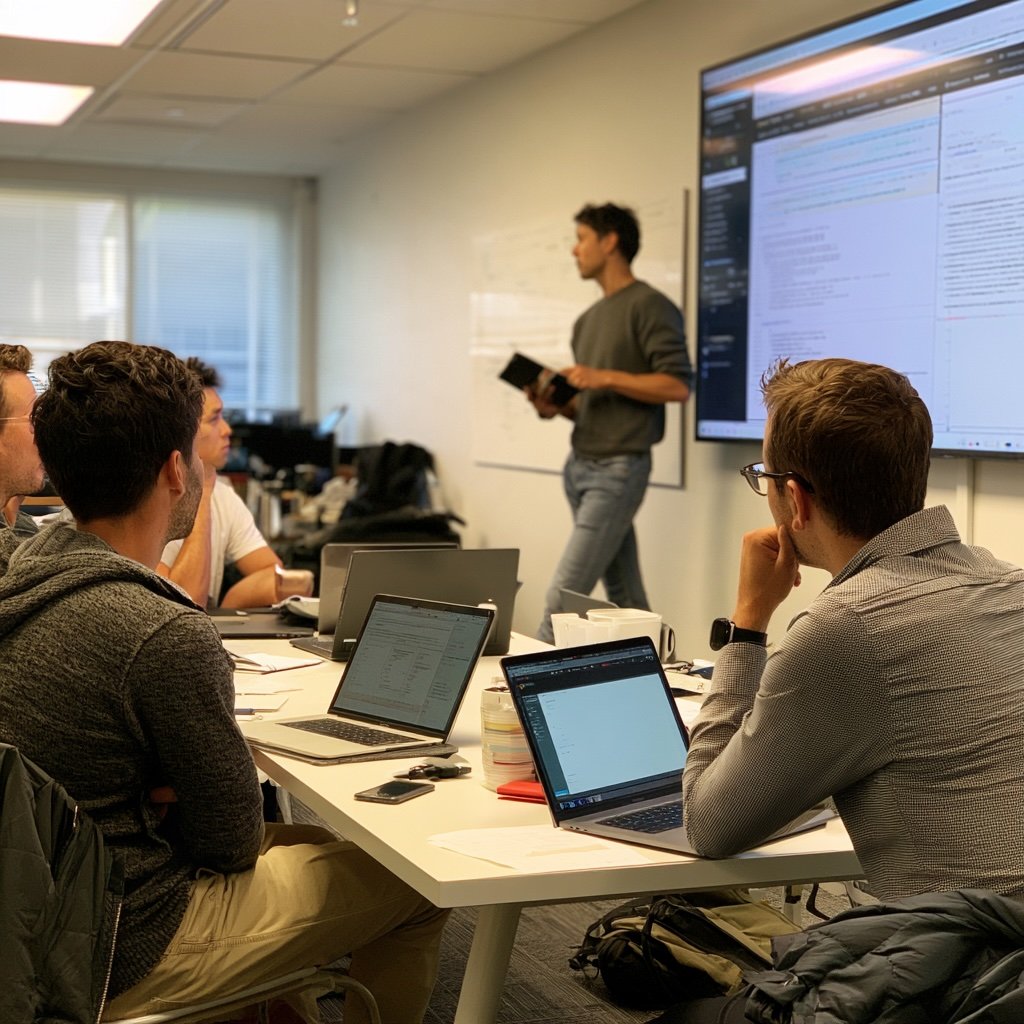

Most people learn to prompt AI by trial and error. They type something, get a mediocre answer, and try again. That works. However, it wastes a lot of time. Good prompt engineering training replaces guesswork with a repeatable method. So whether you are training yourself or a whole team, here is a practical guide to doing it well.
Why Prompt Engineering Training Still Matters
You may have heard that prompting is dead because models keep getting smarter. That is only half true. Newer models do forgive sloppy prompts more than older ones. Still, clear instructions consistently produce better work.
Meanwhile, workers are not getting much help. Microsoft and LinkedIn found that 66% of leaders would not hire someone without AI skills. Yet only 39% of AI users had received employer training (Microsoft & LinkedIn, 2024). That gap leaves most people figuring it out on their own.
As a result, teams pick up random tricks from social media—some help, but not all. Many do not. Structured training fixes that by focusing on what holds up under testing. Plus, untrained users tend to give up early. They try AI once, get a weak answer, and decide it is not worth the effort.
Ditch the Magic Tricks
Let’s start with what to unlearn. Researchers at Wharton have tested many popular prompting habits, and the results are humbling. For instance, being polite or demanding toward the AI can help on one question and hurt on another (Meincke et al., 2025a). In other words, no universal magic phrase exists.
Similarly, assigning an expert persona, like telling the AI it is a world-class physicist, did not improve factual accuracy on tough benchmark questions (Basil et al., 2025). That surprises many people, since persona tips are everywhere.
Even chain-of-thought prompting has changed. Asking a model to think step by step used to give big gains. Now, with reasoning models, those gains are often modest (Meincke et al., 2025b). Therefore, training should focus less on tricks and more on clear communication.
Teach the Fundamentals
So what should training cover instead? First, teach people to state the goal clearly. What is the task, who is the audience, and what does a great result look like?
Next, show them how to give context. AI cannot read minds. It needs background, examples, and constraints. For example, a prompt that includes a sample paragraph in the right tone will usually beat one that says “make it friendly.”
Then, cover format. Tell the model how long the answer should be and how to structure it. Additionally, teach people to break big jobs into smaller steps. A long report works better as an outline first, then sections.
Finally, stress review. Every output needs a human check, especially for facts, numbers, and anything customer-facing.
Move From Prompts to Context
As AI agents become common, the skill is expanding. Anthropic describes this shift as context engineering: managing all the information a model sees, not just the instructions you type (Anthropic, 2025). That includes documents, tool results, and conversation history.
For teams, this changes what training looks like. Beyond writing good prompts, people need to decide what data to feed the model. They also need to know when too much information starts to confuse it.
Consequently, advanced training should include hands-on practice with real workflows. For instance, have employees build a simple assistant for a task they do every week. Along the way, they will see which details matter and which add noise.
Build a Prompt Engineering Training Program That Sticks
Now, how do you turn all this into a program? Start small. A short workshop on fundamentals gives everyone a shared base. After that, run weekly practice sessions using real tasks from each department.
Moreover, create a shared library of prompts that work. When someone finds a strong approach, they add it, along with notes on why it works. Over time, that library becomes one of your most useful assets.
Equally important, measure progress. Track time saved, output quality, and how often people need to redo AI work. Then adjust the training based on the results. Lastly, update the program often. Models change every few months, so what worked in spring may feel outdated by fall.
Final Thoughts
In the end, prompting is a lot like managing. You set clear goals, give good context, and check the work. Strong prompt engineering training builds those habits across your team. And once those habits stick, AI stops being a slot machine and starts being a reliable partner. So start this month. Even one short session can change how your team works.
References
Anthropic. (2025, September 29). Effective context engineering for AI agents. https://www.anthropic.com/engineering/effective-context-engineering-for-ai-agents
Basil, S., Shapiro, I., Shapiro, D., Mollick, E., Mollick, L., & Meincke, L. (2025). Prompting science report 4: Playing pretend: Expert personas don’t improve factual accuracy (arXiv:2512.05858). arXiv. https://arxiv.org/abs/2512.05858
Meincke, L., Mollick, E., Mollick, L., & Shapiro, D. (2025a). Prompting science report 1: Prompt engineering is complicated and contingent (arXiv:2503.04818). arXiv. https://arxiv.org/abs/2503.04818
Meincke, L., Mollick, E., Mollick, L., & Shapiro, D. (2025b). Prompting science report 2: The decreasing value of chain of thought in prompting (arXiv:2506.07142). arXiv. https://arxiv.org/abs/2506.07142
Microsoft & LinkedIn. (2024). 2024 Work Trend Index annual report: AI at work is here. Now comes the hard part. Microsoft WorkLab. https://www.microsoft.com/en-us/worklab/work-trend-index/ai-at-work-is-here-now-comes-the-hard-part