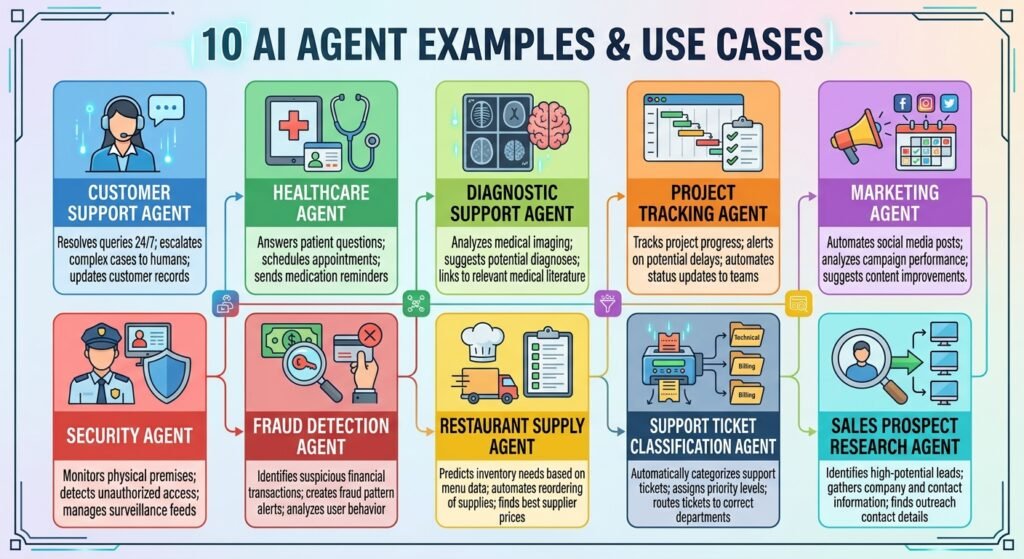

People often picture AI agents as something futuristic, still years away from everyday use. In reality, many of these systems already run quietly inside businesses today. Concrete AI agent examples make this much easier to grasp than any abstract definition ever could. This post walks through ten real situations where agents are doing meaningful work right now, across support, sales, healthcare, and beyond. Hence, the concept stops feeling theoretical and starts feeling practical.
AI Agent Examples And What Separates Them From Chatbots
Before diving into AI agent examples, it helps to understand what makes an agent different from a basic chatbot. A chatbot responds to a single prompt using only the conversation in front of it. An agent plans multi-step tasks, calls outside tools, checks databases, and keeps working toward a goal without needing a human to guide every single step (Startup House, 2026). That independence is the whole point, and it is what lets agents handle work that used to require a person sitting there clicking through several systems.
Customer support is the most visible category right now. Agents built for this purpose read incoming requests, check account details, take the needed action, and close the loop directly with the customer, escalating only when something falls outside a defined policy boundary (Liqteq, 2026). One well-known deployment handled well over two million customer conversations in its first month alone, doing work that would have needed a much larger human team.
Healthcare Agents Handling Real Administrative Weight
Healthcare has become a surprisingly rich source of AI agent examples. Hospitals and health systems are running agents that read denial letters, assemble corrected documentation, and route appeals for nurse approval, cutting a claims process that once took over two weeks down to just a day or two (Keragon, 2026). Given how much time physicians spend on prior authorization paperwork, automating even part of that workflow frees up serious clinical capacity.
Diagnostic support is another area worth mentioning. Agents that analyze medical images can flag the most urgent cases for radiologist review, acting as a first-pass filter rather than replacing the specialist entirely. Scheduling and remote monitoring round out the picture, with agents handling appointment logistics and tracking patient data between visits so care teams can focus attention where it matters most.
Sales, Marketing, And Everyday Office Work
Not every useful agent lives in a hospital or a call center. Plenty of AI agent examples show up in ordinary office work too. Project tracking agents monitor deadlines, track assignments, and send reminders automatically, keeping teams on schedule without constant manual check-ins. Sales teams use agents to research prospects, draft outreach, and update CRM records after every call, cutting down on the administrative grind that used to eat into actual selling time.
Marketing teams lean on agents for a similar reason. Instead of a person manually pulling campaign data from five different tools, an agent can gather it, summarize performance, and flag underperforming campaigns for review. Ticket classification is another practical use case: agents identify intent and urgency in support requests, then route each one to the correct queue automatically rather than leaving that judgment call to whoever happens to be free.
Security, Finance, And Operations
Security teams increasingly rely on agents for tier-one threat response. These systems monitor network activity continuously, automatically isolate compromised systems, and escalate anything unusual to a human analyst rather than waiting for someone to notice a problem manually (Liqteq, 2026). Given how fast modern attacks move, that speed advantage matters enormously.
Finance offers another strong set of AI agent examples, particularly around fraud detection. Large financial institutions have used agent-based systems to save enormous sums by catching fraudulent transactions in real time, not after the fact. Restaurant and food service operators, meanwhile, use agents to forecast ingredient demand and automatically generate supplier orders before stock runs low, cutting both waste and last-minute shortages.
What The Best AI Agent Examples Have In Common
Looking across all ten cases, a pattern emerges. The most successful AI agent examples share three traits. They tackle repetitive, well-defined tasks rather than vague or highly judgment-heavy work. They include a clear escalation path so a human steps in when something falls outside normal boundaries. And they connect directly to the systems where the actual work happens, rather than sitting off to the side generating suggestions nobody acts on.
Teams considering their own first deployment would do well to start with a workflow that fits this pattern closely. Pick something measurable, give the agent clear boundaries, and build in a way for a person to catch mistakes early. That approach turns an interesting idea into something that quietly saves real time every single day.
References
Keragon. (2026, May 22). AI agent examples. 10 real-world use cases in 2026.
https://www.keragon.com/blog/ai-agent-examples
Liqteq. (2026, July 13). 15 real-world AI agent use cases across industries. 2026 guide.
https://liqteq.com/blog/ai-agent-use-cases/
Startup House. (2026, August 7). AI agent use cases. Real-world examples for 2026.
https://startup-house.com/blog/ai-agents-use-cases
Lindy. (2026, August 7). Top 24 AI agent examples for 2026. Real-world use cases.
https://www.lindy.ai/blog/ai-agents-examples
Planetary Labor. (2026). AI agents examples. 30+ real-world use cases in 2026.
https://planetarylabour.com/articles/ai-agents-examples