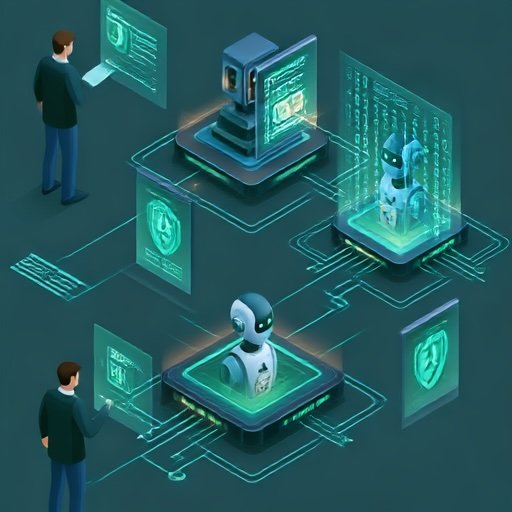

Cybersecurity for AI Agents is now a top challenge because these agents execute actions—such as calling APIs, writing to databases, and triggering workflows—across connected systems with little oversight. This new behavior requires a complete rethink of defense strategies. Let’s examine exactly where enterprises are succeeding and falling short this year.
Agents Are Actors, Not Tools
The core mistake many enterprises make is treating AI agents as conventional software and applying outdated security approaches. Unlike static applications protected by firewalls, AI agents reason, act, and chain workflows across systems, resembling high-privilege employees.
Security leaders increasingly describe this shift in the same way, noting that securing an actor is fundamentally different from securing a tool. Enterprises are projected to embed task-specific agents into a large share of applications this year, which means the attack surface is expanding just as fast as adoption itself. Security teams that wait for a mature framework before acting will likely fall behind that curve.
Where the Real Attacks Happen
Traditional security tools protect the model layer by inspecting prompts and responses for obvious policy violations. However, the actual attack increasingly occurs at the tool-call layer, where an agent invokes an API, writes to a database, or triggers a workflow with real consequences. Most enterprises have almost no governance at this specific layer.
Prompt injection is the phishing of the AI era. Malicious instructions in documents, webpages, or emails can redirect an agent’s behavior without the owner’s knowledge. Agents act at machine speed, spreading damage before humans notice. By the time a review occurs, the agent may have already affected many systems, moving data or triggering actions too quickly for manual review to catch.
Cybersecurity for AI Agents Starts With Ownership
Experts agree that the right sequence is ownership, then constraints, then monitoring. Before deploying any agent, define who is responsible, restrict permissions to only what’s required, and enforce action-level guardrails before monitoring.
Each agent needs a managed identity with scoped authentication, not a shared credential with broad access. If your team can’t state an agent’s capabilities, on whose behalf it acts, or who approved access, your organization isn’t ready for these systems’ autonomy. Clear answers to these questions are the first security test.
Cybersecurity for AI Agents Needs Defense in Depth
No single control solves this, so layered defense is critical. At the model layer, choose models tuned for safer behavior, but tuning can’t guarantee safety. For the safety system layer, use content filters and groundedness detection to catch what the model misses.C
At the application layer, bound autonomy is achieved through careful permissioning, escalation paths, and detailed logging that ties every action back to a specific agent identity. As organizations manage growing numbers of agents and integrations, this identity clarity becomes operationally critical rather than a nice-to-have addition bolted on after deployment. Skipping it early usually means retrofitting identity controls onto systems already running in production, which is far harder than designing them correctly from the very first deployment.
What Security Teams Should Do Next
Start by mapping every agent currently running in your environment, including shadow deployments spun up by individual teams without formal review. Many organizations report limited visibility into which agents are even communicating with each other, and you cannot secure what you cannot see.
From there, prioritize an AI agent gateway that intercepts tool invocations before execution, scores risk, and routes high-stakes actions to human approval before anything irreversible happens downstream across connected production systems, so no one can react in time to stop it. The organizations that treat every new agent deployment with the same scrutiny as a privileged service account will avoid the incidents that are already starting to hit less careful competitors across nearly every industry.
References
Bessemer Venture Partners. (2026). Securing AI agents: The defining cybersecurity challenge of 2026.
https://www.bvp.com/atlas/securing-ai-agents-the-defining-cybersecurity-challenge-of-2026
NeuralTrust. (2026). The complete guide to AI agent security for enterprises 2026.
https://neuraltrust.ai/blog/ai-agent-security-enterprises-complete-guide
Microsoft Security Blog. (2026). Defense in depth for autonomous AI agents.
https://www.microsoft.com/en-us/security/blog/2026/05/14/defense-in-depth-autonomous-ai-agents/
Help Net Security. (2026). Enterprises are racing to secure agentic AI deployments.
https://www.helpnetsecurity.com/2026/02/23/ai-agent-security-risks-enterprise/