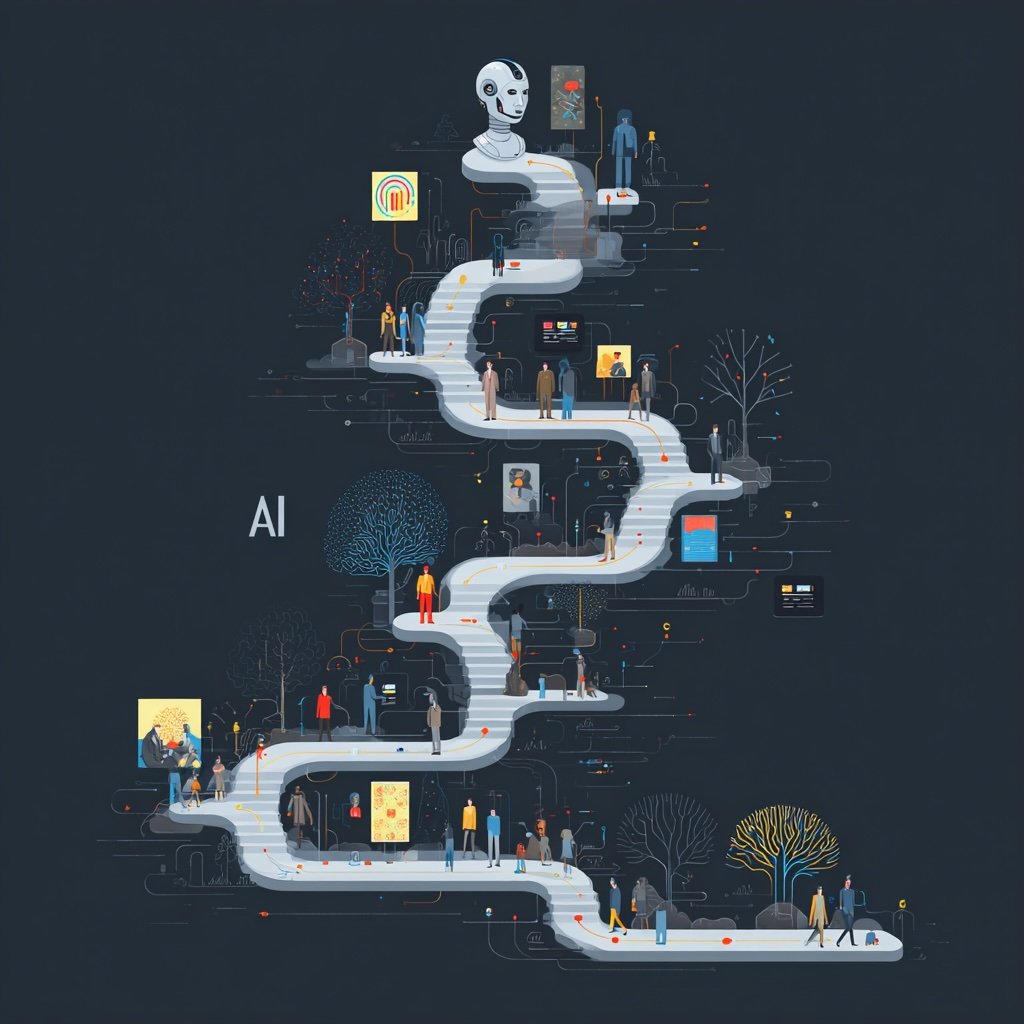

Your AI Career Roadmap Starts Here
The job market is changing fast. Artificial intelligence is now present across finance, healthcare, marketing, education, and more. Building a clear AI career roadmap is important in every industry and for every background.
The good news is that AI is creating more opportunities than it is closing off. The World Economic Forum (2025) projects that AI will help generate around 170 million new roles globally by 2030, even as some older roles evolve or disappear. That means real room for career growth exists if you position yourself well.
Not every role looks the same in an AI-driven world, though. A marketer, a nurse, a lawyer, and a software developer each face distinct challenges and distinct opportunities. The key is understanding what your specific role requires in this new landscape.
How AI Is Reshaping the Workplace
Before diving into role-specific paths, it helps to understand the bigger picture. AI is not simply automating jobs. It is changing the nature of work itself. Many tasks within roles are being augmented, meaning humans and AI collaborate rather than AI replacing humans entirely.
LinkedIn’s research found that job postings mentioning AI skills have grown significantly year over year across nearly every industry (LinkedIn, 2024). Furthermore, roles that combine AI fluency with soft skills like leadership and empathy are seeing the strongest demand.
This shift is gradual but steady. For most workers, the challenge is not losing their job overnight. Rather, it is keeping pace with evolving expectations. Employers increasingly want people who can work alongside AI tools, interpret AI outputs, and apply sound human judgment where machines fall short. Preparation, therefore, is everything.
The Tech Side for Developers and Data Professionals
For software developers and data professionals, the path involves both challenge and opportunity. On one hand, AI tools like GitHub Copilot are already writing code. On the other hand, experienced developers who understand how to direct, debug, and deploy AI systems are more valuable than ever.
McKinsey and Company found that demand for advanced technical roles in AI, machine learning, and data engineering is growing sharply, even as routine coding tasks get automated (McKinsey & Company, 2024). So the shift is less about replacement and more about elevation.
Developers who thrive will be those who move up the stack. Instead of writing boilerplate code, they will design AI-powered systems, evaluate model performance, and solve complex architectural problems. Likewise, data professionals are finding that their skills translate well into roles like AI trainer, data strategist, and machine learning operations engineer.
Additionally, soft skills matter more now than ever before. Communication, project leadership, and business acumen help technical professionals stand out in a crowded field. The developer who can explain AI trade-offs to a non-technical executive is a rare and very valuable asset.
The Business Side for Managers, Analysts, and Strategists
Business professionals are navigating a significant transition. Managers, analysts, and strategists may not write code, but they need to understand what AI can and cannot do. Moreover, they need to lead their teams through AI-driven change effectively.
IBM’s research shows that most organizations are not held back by technology. Instead, they are held back by a lack of AI-ready talent in leadership and strategic roles (IBM Institute for Business Value, 2024). That finding puts business professionals in a powerful position. Learning to harness AI is a genuine career differentiator right now.
Analysts benefit most from learning how to prompt tools correctly, evaluate AI-generated insights critically, and combine machine output with human context. Managers, meanwhile, need to understand how to redesign workflows around AI capabilities. Strategists, on the other hand, focus on identifying where AI creates competitive advantage for their organization.
Transition into these enhanced roles does not require a computer science degree. Instead, it requires curiosity, adaptability, and a willingness to learn on the go. Many business schools and online platforms now offer short courses in AI fundamentals tailored specifically for non-technical professionals.
The Creative Side for Writers, Designers, and Marketers
The creative world is experiencing a genuine upheaval. Generative AI tools can now write copy, generate images, produce video, and compose music. So it is natural for writers, designers, and marketers to feel uncertain. Nevertheless, the picture is more nuanced than it first appears.
AI tools excel at volume and speed. They struggle with original thought, cultural sensitivity, brand voice, and genuine emotional resonance. Those qualities remain deeply human strengths. Consequently, creative professionals who learn to use AI as a collaborator rather than a competitor are well-positioned.
Marketers, for example, are using AI to analyze audience data, generate content variations, and personalize campaigns at scale. Then they apply their own strategic thinking to shape the overall narrative. Designers are using AI image generation for rapid ideation while relying on their trained eye to refine and curate the final product.
New roles are emerging at the intersection of creativity and AI, such as prompt engineers, AI content strategists, and creative technologists. For those willing to evolve, the AI career roadmap offers exciting new territory.
Healthcare, Education, and the Human-Centered Roles
Some professions are deeply human by nature. Healthcare workers, educators, social workers, and counselors operate in spaces where empathy, judgment, and human connection are central. AI is entering these fields too, but its role is supportive rather than dominant.
In healthcare, AI is being used to analyze medical images, flag potential diagnoses, and streamline administrative tasks. Coursera’s Global Skills Report (2024) notes that healthcare workers who add data literacy to their skill set are finding new pathways into roles like clinical informatics and health AI coordination. Those roles sit at the crossroads of medicine and technology.
In education, AI tutoring tools are beginning to personalize learning for students in meaningful new ways. Teachers who understand how to integrate these tools thoughtfully become far more effective in the classroom. Beyond that, they become essential guides who help students navigate an AI-rich world with critical thinking fully intact.
For human-centered professionals, the path forward involves embracing AI as an assistant while doubling down on the irreplaceable human qualities their work demands. Compassion, trust, and relational intelligence cannot be replicated by any current model.
Building an AI Career Roadmap for Your Role
Now that we have looked at specific fields, let us talk about how to build your personal AI career roadmap. The process starts with an honest assessment of your current skills and the specific ways AI is entering your industry. From there, the steps forward become much clearer.
Begin with awareness. Read industry reports, follow thought leaders in your field, and pay close attention to how your colleagues and competitors are using AI tools. Awareness is the foundation of every smart career move.
Next, build targeted knowledge. You do not need to master machine learning theory. However, understanding how large language models work, what they are good at, and where they fail gives you a real advantage. Many free and affordable resources are available across platforms such as Coursera, LinkedIn Learning, and edX.
After that, experiment actively. Use AI tools in your current role. Try different prompting strategies. Notice where AI helps and where it creates errors that require human correction. That firsthand experience is invaluable and builds confidence fast.
Finally, document what you learn. Add AI-related projects to your portfolio. Update your resume and LinkedIn profile to reflect your growing expertise. Employers notice, and that visibility opens real doors.
Where to Start Right Now
The single most important thing you can do today is take one small step. Read one article about AI in your field. Try one AI tool for a task you already do. Take one short course that demystifies the technology for you. Small, consistent actions compound quickly over time.
Remember that the AI career roadmap is not a single fixed path. It is a living, evolving guide that shifts as technology and industry needs shift alongside it. The professionals who succeed are not necessarily the ones who know the most about AI. They are the ones who stay curious, stay adaptable, and never stop learning.
The future of work is genuinely exciting. AI is a tool, and like every powerful tool, it rewards those who learn to use it well. Your next career chapter is already taking shape. The only question is how deliberately you choose to shape it.
References
Coursera. (2024). Global Skills Report 2024. https://www.coursera.org/skills-reports/global
IBM Institute for Business Value. (2024). Augmented work for an automated, AI-driven world. https://www.ibm.com/thought-leadership/institute-business-value/en-us/report/augmented-work
LinkedIn. (2024). Future of work report: AI at work. https://economicgraph.linkedin.com/research/future-of-work-report-ai
McKinsey & Company. (2024). The economic potential of generative AI. https://www.mckinsey.com/capabilities/mckinsey-digital/our-insights/the-economic-potential-of-generative-ai-the-next-productivity-frontier
World Economic Forum. (2025). Future of Jobs Report 2025. https://www.weforum.org/reports/the-future-of-jobs-report-2025/