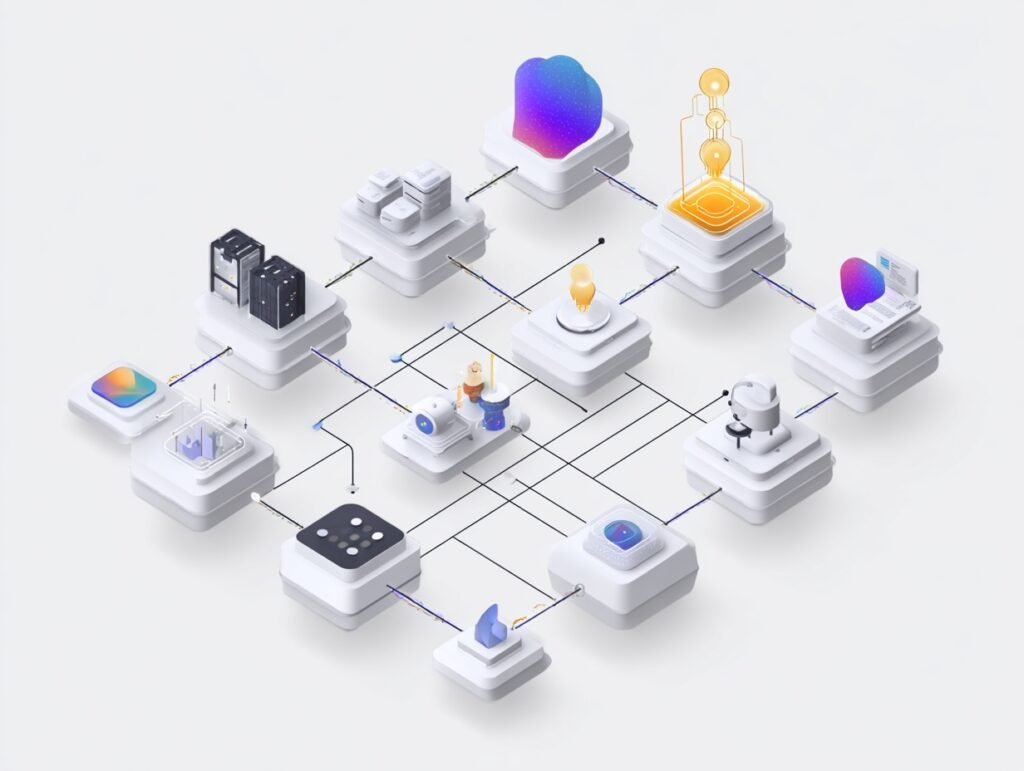

The way developers build software has changed dramatically over the last decade. More teams are moving away from monolithic architectures and embracing modular, scalable approaches. The AI microservices workflow sits at the heart of this shift. It combines intelligent tooling, automated pipelines, and independently deployable services into one cohesive development process. Understanding how this workflow comes together is the first step toward building faster, smarter, and more resilient applications.
Why Microservices Changed the Development Game
Microservices architecture broke software into small, independently deployable units. Each service handles one specific task. Teams can update, scale, and deploy each piece without touching the rest of the system. That flexibility proved transformative. However, it also introduced new layers of complexity.
Managing dozens of services takes serious coordination. Consequently, developers began searching for smarter tools to handle that growing complexity. Narváez et al. (2025) confirmed that challenges around service decomposition, inter-service communication, and data consistency pushed teams toward AI-based design solutions. In short, the inherent complexity of microservices created the demand for AI assistance in the first place.
The relationship between microservices and AI was never a coincidence. Both thrive on modularity and independence. Together, they form a natural partnership that researchers and practitioners have been actively exploring and refining for years.
How AI Fits Into the AI Microservices Workflow
Artificial intelligence changed the game by automating many repetitive decisions that developers used to make by hand. Rather than manually defining service boundaries, AI tools can analyze codebases and automatically suggest decomposition strategies. Similarly, machine learning models can monitor service health and predict failures before they occur.
Furthermore, natural language processing tools help developers write and review code more efficiently. Tools like GitHub Copilot and Cursor have become standard components of many development stacks. Together, these technologies reshaped how teams approach design, development, testing, and deployment in a microservices environment.
Moreschini et al. (2025) mapped over 269 peer-reviewed papers on AI techniques in the microservices lifecycle. Their research found that most AI applications have concentrated on the deploy, operate, and monitor phases. However, there is significant momentum toward bringing AI into earlier stages, such as requirements analysis and automated code refactoring. That shift is already visible in forward-thinking engineering teams.
Service Decomposition in the AI Microservices Workflow
One of the trickiest parts of working with microservices is deciding how to break a system into pieces. Service decomposition sounds simple, but it rarely is. Get it wrong, and services end up too tightly coupled or too granular to be practical. This is precisely where the AI microservices workflow proves its value most clearly.
AI techniques such as clustering algorithms and machine learning models can analyze existing codebases and recommend service boundaries. Narváez et al. (2025) found that clustering remains one of the most widely used AI techniques for identifying service candidates and refining service granularity. Beyond that, reinforcement learning and neural networks are being applied to dynamically adjust resource allocation as services evolve.
Furthermore, tools like Mono2Micro use AI to assist teams migrating from monolithic systems to microservice architectures. This kind of tooling drastically reduces the time and guesswork involved in decomposition. As a result, teams can invest more energy in building features rather than debating architectural decisions.
Building the Right Development Environment
Before the workflow can run smoothly, teams need the right environment in place. That means setting up containerization, orchestration platforms like Kubernetes, and service-mesh layers for traffic management. These foundations create the infrastructure that AI tools later optimize and manage.
AI code assistants play a growing role during the implementation phase. They suggest completions, catch potential bugs, and even generate boilerplate for API definitions. The Stack Overflow 2024 Developer Survey found that 76% of developers spend more than half their time on maintenance tasks rather than innovation (Stack Overflow, 2024). AI tooling directly addresses that problem by offloading repetitive, time-consuming work.
Moreover, version control workflows have evolved alongside AI. Pull request reviews now often include AI-generated summaries and risk assessments. Consequently, code review cycles have shortened considerably. Teams merge changes faster and with greater confidence. The combination of strong infrastructure and AI-assisted development lays a solid groundwork for everything else that follows.
Testing and Integration Across Services
Testing microservices comes with its own set of challenges. Each service needs to work correctly on its own. Beyond that, it also needs to communicate reliably with every other service in the system. Integration testing in microservice environments takes significantly more time than in traditional monolithic setups.
AI is starting to change that dynamic. Intelligent test generation tools can automatically generate test cases from API specifications and historical failure data. Consequently, teams catch more bugs with less manual effort. Furthermore, AI-powered test runners can prioritize which tests to run based on recent code changes, providing developers with faster, more targeted feedback.
Beyond standard integration tests, AI tools are increasingly used for contract testing across microservices. Contract testing ensures that changes to one service do not accidentally break the expectations of its consumers. With AI flagging potential contract violations early, teams sidestep costly regressions in production. The testing phase becomes both more thorough and more efficient as a result.
Deployment, Observability, and the AI-Driven Operations Layer
Deploying microservices once required careful manual coordination. Today, AI-driven CI/CD pipelines automate much of that process. These pipelines analyze code changes and determine which services need redeployment. They also manage rollback strategies automatically if a deployment causes performance degradation.
Observability is where AI delivers remarkable value in a microservices context. With dozens of services generating logs, metrics, and traces simultaneously, no human team can track everything manually. AIOps platforms step in to fill that gap. They use machine learning to analyze telemetry data and identify anomalies before they escalate into full outages.
Autonomous AI agents represent an especially exciting development in this space. Willard and Hutson (2025) explored how such agents can independently manage microservices communication and workflow orchestration with minimal human intervention. Their research found that AI agents have real potential to handle routine management tasks including load balancing, resource allocation, and service monitoring. As these capabilities mature, self-healing microservice systems are becoming a realistic expectation rather than a distant aspiration.
What Comes Next for the AI Microservices Workflow
The research points to a clear trajectory. AI and microservices are becoming increasingly intertwined with each passing year. Moreschini et al. (2025) noted that the field has expanded substantially since its first peer-reviewed publications appeared in 2017. Even so, meaningful gaps remain. Requirements analysis and automated code refactoring are still underdeveloped areas where AI could provide enormous value in the near term.
Meanwhile, as organizations lean further into cloud-native development, microservices will only become more prevalent. Gartner projected that roughly 85% of new applications would follow a cloud-first principle by 2025, which would naturally accelerate the further adoption of microservice architectures. Pair that trend with the rapid advancement of AI tooling, and you have a development landscape shifting at a remarkable pace.
Teams that take the time to understand and implement a thoughtful AI microservices workflow today will be far better positioned for what comes next. The tools are ready. The research is detailed. The next step is putting it all into practice.
References
Moreschini, S., Pour, S., Lanese, I., Balouek, D., Bogner, J., Li, X., Pecorelli, F., Soldani, J., Truyen, E., & Taibi, D. (2025). AI techniques in the microservices life-cycle: A systematic mapping study. Computing, 107(4), Article 100. https://doi.org/10.1007/s00607-025-01432-z
Narváez, D., Battaglia, N., Fernández, A., & Rossi, G. (2025). Designing microservices using AI: A systematic literature review. Software, 4(1), 6. https://doi.org/10.3390/software4010006
Stack Overflow. (2024). Stack Overflow developer survey 2024. https://survey.stackoverflow.co/2024/
Willard, J., & Hutson, J. (2025). The evolution and future of microservices architecture with AI-driven enhancements. International Journal of Recent Engineering Science, 12(1), 16–22. https://doi.org/10.14445/23497157/IJRES-V12I1P103