
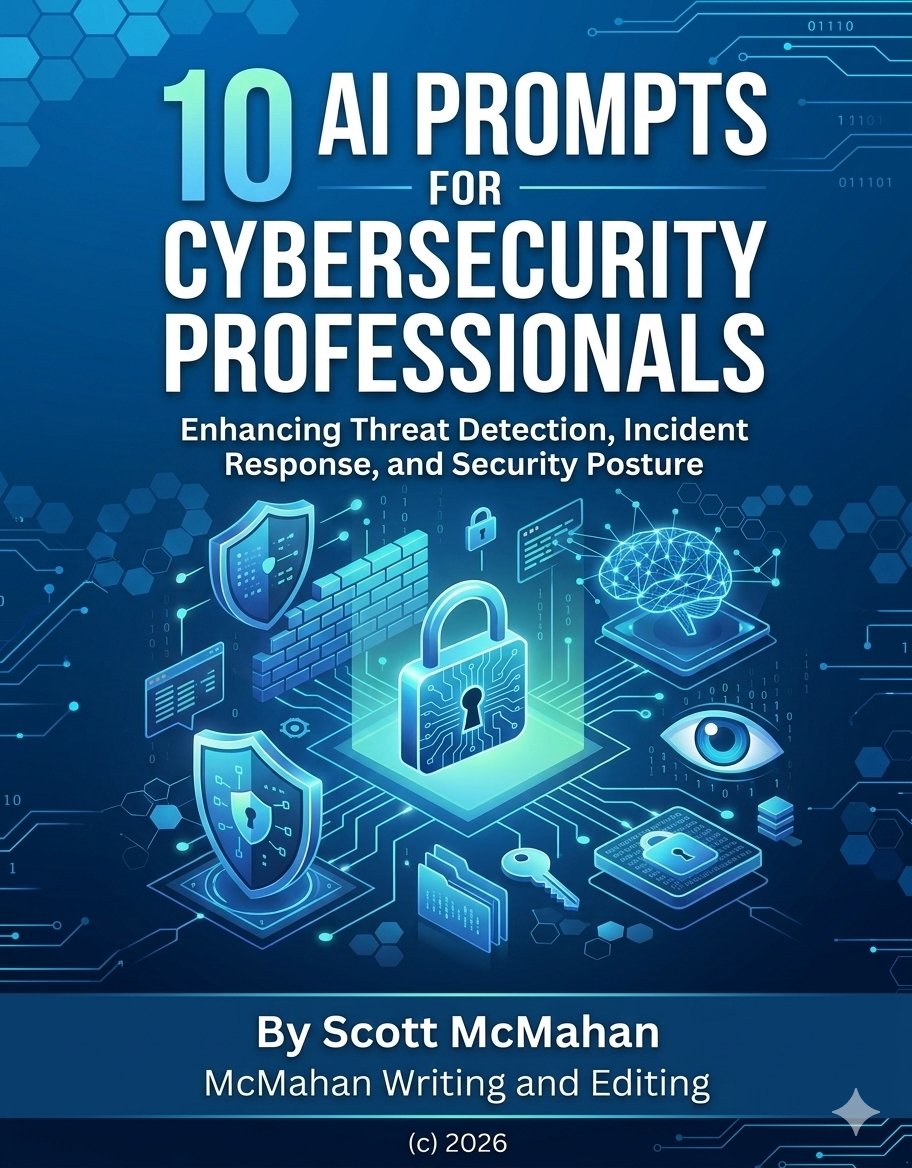
Description
If you work in cybersecurity, your to-do list never really shrinks. Threat intelligence piles up every morning. On top of that, incident response playbooks go stale. Meanwhile, policies need updating. And none of that accounts for the fires that start without warning. Fortunately, AI tools can take a serious bite out of that workload. The catch, however, is that they only deliver results when you know how to prompt them correctly.
That is exactly what this guide is for.
10 AI Prompts for Cybersecurity Professionals gives you ten field-tested AI prompts for cybersecurity work you can copy, paste, and customize today. Each prompt is built for a specific security task. Beyond that, each one comes with a plain-English explanation of why it works. And to make it even more practical, each one includes a real-world case study so you can see it in action before you try it yourself.
According to the IBM Security Cost of a Data Breach Report (2025), organizations using AI-assisted security tools reduced their mean time to identify a breach by an average of 74 days. That kind of efficiency gap is hard to ignore. As a result, these prompts are designed specifically to help you close it.
Here is what is inside.
Prompt 1 — Threat Intelligence Summarization. Turn dense vendor reports into clear, executive-ready briefings. More importantly, this prompt produces output that works for your SOC team and your CISO at the same time, so you stop writing the same summary twice.
Prompt 2 — Incident Response Playbook Creation. Build scenario-specific IR playbooks fast. Rather than producing generic advice, this prompt anchors the output in your actual environment so the result is immediately actionable. As a bonus, it is written so a junior analyst can follow it under pressure.
Prompt 3 — Phishing Email Analysis. Go beyond header checks. In addition to surfacing technical indicators, this prompt identifies the psychological manipulation tactics attackers use. As a result, briefing non-technical stakeholders becomes much easier and faster.
Prompt 4 — Security Policy Drafting. Write policies employees actually read. This prompt balances plain-English clarity with the precision SOC 2 and other frameworks require. Furthermore, the SANS 2026 Security Awareness Report confirms that readable policies drive measurably higher compliance rates than technically dense alternatives.
Prompt 5 — Vulnerability Prioritization. Stop drowning in scan findings. Instead of ranking every vulnerability individually, this prompt groups them into three actionable tiers based on real-world exploitability and business impact. In addition, it aligns with CISA’s 2026 vulnerability management guidance so your prioritization is defensible to auditors and leadership alike.
Prompt 6 — Security Awareness Training Content. Create scenario-based training that actually changes behavior. To that end, this prompt builds realistic narratives around the attack patterns your organization actually faces. The SANS 2026 report found that scenario-driven modules reduce simulated phishing click rates by an average of 64 percent compared to lecture-style alternatives, which makes the investment in good content well worth it.
Prompt 7 — Penetration Testing Report Narratives. Draft reports that serve both your technical team and executive leadership. In other words, one document, two audiences. The Ponemon Institute (2026) finds that business-risk framing significantly increases the likelihood of timely remediation funding, so this prompt pays for itself quickly.
Prompt 8 — Risk Assessment Documentation. Produce thorough, audit-ready risk assessments. Unlike generic risk tools that spit out numbers without context, this prompt builds in narrative justification for every risk rating. Consequently, your reasoning is transparent and defensible when auditors and executives push back.
Prompt 9 — Compliance Gap Analysis. Speed up your SOC 2, NIST CSF, or ISO 27001 prep. Rather than dumping a flat list of gaps on you, this prompt classifies every finding as a policy, technical, or process issue from the start. That distinction matters because each type requires a fundamentally different remediation approach. As a result, building a project roadmap from the output becomes significantly faster.
Prompt 10 — Zero Trust Architecture Planning. Build a realistic, phased zero trust roadmap that accounts for your team size and your budget. Beyond the roadmap itself, this prompt includes a built-in request for 30-day quick wins. That way, leadership sees tangible progress right away, which in turn keeps the program funded and moving forward.
Taken together, these AI prompts for cybersecurity professionals cover the full range of tasks that slow security teams down most. The guide draws on research from IBM Security, Verizon, CISA, NIST, MITRE ATT&CK, SANS Institute, and Ponemon Institute, with sources ranging from 2024 through 2026. Every recommendation is therefore grounded in current industry data rather than guesswork.
These prompts are compatible with ChatGPT, Claude, Microsoft Copilot, and most major AI assistants. No software installation is required. No technical background is needed to put them to work. Simply open the guide, find the prompt that fits your task, and start saving time.
Download your free copy and start getting more out of every AI session.
Product Notes
Format: PDF, 13 pages. Compatible with ChatGPT, Claude, Microsoft Copilot, and most major AI assistants. No software installation required. References reflect 2024 and 2025 industry sources.
.
© 2026 McMahan Writing and Editing | All Rights Reserved.
Reviews
There are no reviews yet.