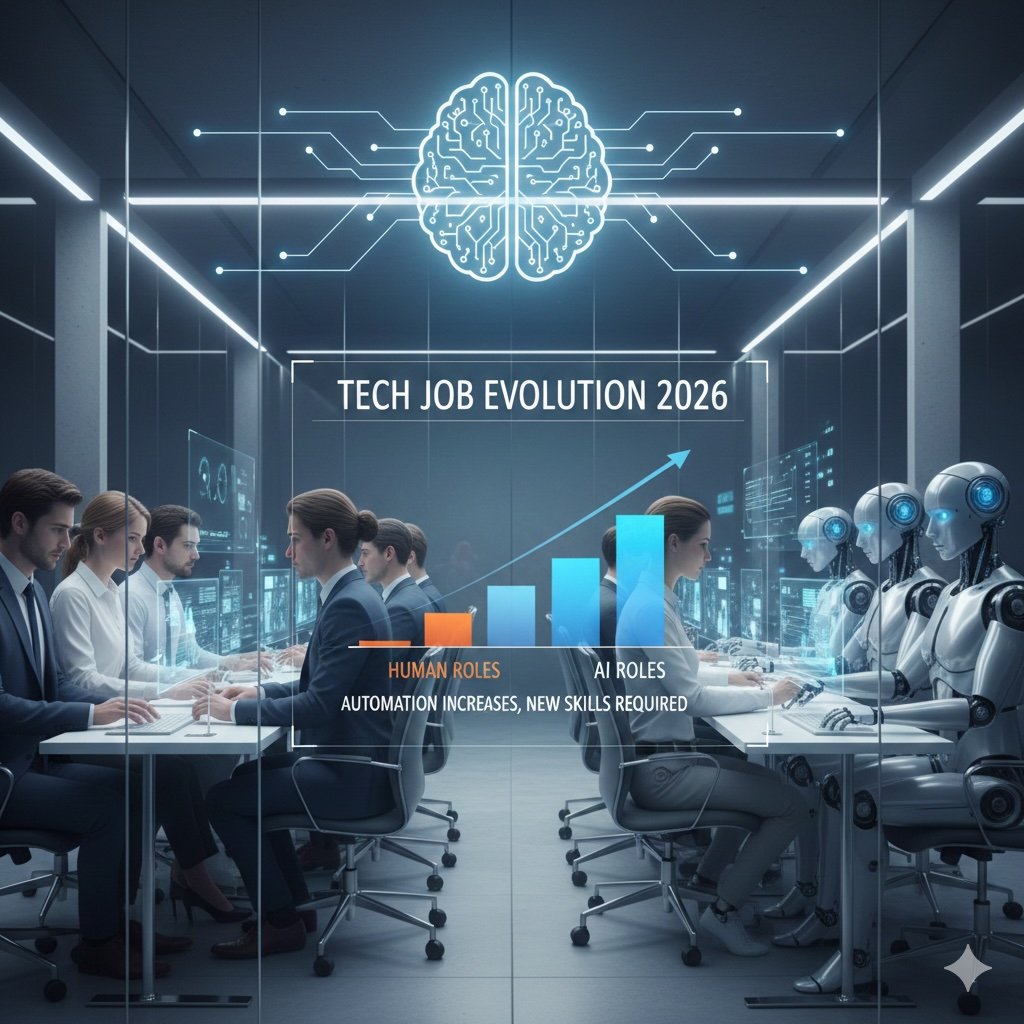

Who Gets Promoted, Who Gets Replaced, And Why
If you work in tech, you have felt the mood change around AI impact on tech jobs 2026. A few years ago, many teams treated generative AI as a handy add-on. It helped with drafts and sped up small tasks, but it still lived on the edges of the job. People experimented with it, but they did not let it set the pace for the whole team. Even when people felt excited, they still expected their role to work the way it always had.
Now AI sits closer to the center. Leaders want to know who can ship more with the same headcount. They may not say it directly, but the question shows up in budgets and performance expectations. It also shows up in how roles change. People cover more scope, move faster, and still need to hold quality steady. That combination creates the separation you can feel.
The New Ladder Rewards Orchestration with AI Impact on Tech Jobs 2026
The ladder used to reward task completion. Do the work faster, and you move up. That model still exists, but it has weakened because AI can handle many task-shaped activities, especially the ones with stable patterns. As soon as a task becomes repeatable and easy to verify, it drifts toward automation. So the signal shifts upward. Companies value the people who can shape the work, not only the people who can produce it.
This is where orchestration matters. Orchestration means you can take a vague problem and turn it into a clear scope. Then you use AI to accelerate the draft work. After that, you verify the result with professional standards. That final step changes everything, because speed alone no longer stands out. Reliable speed stands out. When you combine pace with judgment, leaders trust you with larger outcomes.
Why Replacement Looks Quiet With AI Impact on Tech Jobs 2026
Replacement rarely arrives as a dramatic moment. People picture a tool taking a job overnight. More often, it shows up as a quiet shift in staffing and expectations. You see hiring freezes that linger. You see teams merge, and a few roles disappear in the overlap. You see one person cover more scope because AI fills in the gaps. From the outside, the company still looks stable. From the inside, the workload distribution changes.
That is why it feels confusing. You might not see someone get replaced. You may just notice fewer openings, slower backfills, and higher throughput expectations. Over time, that changes what a role means, even when the title stays the same. Work gets reorganized around what teams can accelerate. The remaining human work shifts toward ownership, review, and risk control.
The Replacement Zone Is Predictable Output
The highest risk zone tends to involve predictable outputs with low context. The work can be important and still be vulnerable. The key factor is repeatability. When outputs follow stable patterns and teams can measure success with quick checks, AI reduces the hours required to reach an acceptable draft.
If your role focuses on turning inputs into standard deliverables, AI can shrink the time needed. Routine reporting, template driven documentation, simple ticket work, and first pass customer responses often fall into this category. The theme is not easy work. The theme is stable work. That is why replacement pressure often lands on roles that feel busy. Busy does not always mean defensible. When deliverables look similar every week, leaders start thinking about automation and consolidation.
You can still move out of this zone. You do it by owning correctness, not only production. You become the person who can explain why the output is right, where the data came from, and what risks you managed along the way.
Accountability Is The Scarce Skill
As AI makes production cheaper, accountability becomes more valuable. Organizations do not pay for activity. They pay for outcomes they can stand behind. That is why promotions often go to people who deliver results that stay solid under pressure, not only fast results. Speed matters, but it matters most when you can defend the work and correct it when reality disagrees with the first pass.
Accountability includes judgment, but it also includes proof. Can you show your work holds up under review. Can you explain assumptions without hand-waving. Can you trace decisions back to inputs. Can you respond when something breaks by tightening the process instead of blaming the tool. Those are operational skills that protect the business.
Teams also learn a hard lesson here. AI output can sound confident even when it is wrong. That creates reputational, legal, and security risk. So leaders value people who keep AI in a controlled lane and keep quality measurable.
Oversight Has Become A Career Accelerator
As accountability grows, oversight moves from an extra responsibility to a core capability. Oversight means you decide what to automate, what to keep human, and how to evaluate outputs. You also build guardrails that prevent speed from turning into risk. Without guardrails, teams move fast and still create hidden costs later through incidents, rework, and lost trust.
This matters more in regulated and enterprise environments, but it is not limited to them. It also matters in any product that touches sensitive data or high-stakes decisions. Even in less regulated settings, customers notice quality shifts quickly. Trust takes time to build and little time to lose.
Framework thinking helps because it gives teams shared language for risk and controls. When you connect that language to day-to-day delivery, you become valuable in a rare way. You help teams adopt AI without losing control. You help leaders move forward without guessing. That is a fast path to more responsibility in 2026.
Individual Contributor Work Is Starting To Feel Like Systems Management
Once organizations embed AI across workflows, many individual contributor jobs start to resemble systems management. You are not only producing artifacts. You are directing a process that produces artifacts. The shift feels subtle at first, but it changes what the job rewards. The work stops being only output. It becomes the quality of the pipeline that produces output.
In practice, you spend more time defining context and constraints so the system produces useful drafts. You spend more time reviewing outputs and running checks to catch errors early. You spend more time integrating results into a larger system so they do not break downstream. You also spend more time making work observable so others can evaluate and improve it.
This is why some experienced professionals feel unsettled. Companies trained them to be excellent producers. Now companies expect them to operate a pipeline that includes AI and still protect quality. That pipeline mindset becomes a career advantage because it reduces uncertainty for the whole team.
Promotions Follow Trust
Promotions tend to follow trust, especially during change. High trust does not mean someone never makes mistakes. It means results become more predictable when that person is involved. Leaders can assign a problem and expect a solid outcome with fewer surprises. That predictability becomes more valuable as pace increases, because surprises create delays, fires, and costly escalations.
AI raises the stakes. It increases output volume, and higher output volume increases the cost of errors. So businesses value the people who reduce uncertainty. They set standards others can follow. They define what done means in a testable way. They build feedback loops that catch issues early. They communicate risks in plain language so decisions do not stall.
This is also where translation drives promotion. Teams need people who can move between executive goals and technical execution without losing the thread. AI can produce many options quickly. Humans still choose the option that fits the goal and the risk boundary. Trust grows around the people who make that choice reliably.
Build Career Safety Around Judgment And Proof
If you want a practical approach to career safety in 2026, start with one mindset. Treat AI output as a draft. That keeps you in control and keeps you from confusing fluent text with correct work. From there, build habits that turn drafts into dependable results, even when the workflow moves quickly.
This is where judgment shows up. You check assumptions before they become decisions. You validate definitions so teams do not argue over different meanings of the same metric. You test edge cases so failures do not appear in front of customers. You confirm constraints so outputs align with policy and security needs. Then you keep asking whether the result fits the goal, not only whether it sounds plausible.
Proof makes that judgment visible. Proof can include tests, monitoring, decision documentation, and evaluation criteria others can repeat. When leadership sees how you maintain quality, you can defend your value more easily. Over time, that is how you respond to AI impact on tech jobs in 2026 without chasing trends or getting stuck in worry.
References
World Economic Forum. (2025). The Future Of Jobs Report 2025.
https://www.weforum.org/docs/WEF_Future_of_Jobs_Report_2025.pdf
OECD. (2026, January 27). AI Use By Individuals Surges Across The OECD As Adoption By Firms Continues To Expand.
https://www.oecd.org/en/about/news/announcements/2026/01/ai-use-by-individuals-surges-across-the-oecd-as-adoption-by-firms-continues-to-expand.html
Adecco Group. (2026). Workforce Trends 2026 Report.
https://www.adecco.com/-/media/project/adecco/adeccopl/08-reports/the_adecco_group_workforce_trends_2026_report.pdf
Tabassi, E. (2023). Artificial Intelligence Risk Management Framework (AI RMF 1.0). National Institute Of Standards And Technology.
https://www.nist.gov/publications/artificial-intelligence-risk-management-framework-ai-rmf-10
Microsoft. (2025). 2025 The Year The Frontier Firm Is Born. Microsoft WorkLab.
https://www.microsoft.com/en-us/worklab/work-trend-index/2025-the-year-the-frontier-firm-is-born
World Economic Forum. (2026, January 21). 3 Ways To Unite Talent And Employers On The Great Workforce Adaptation.
https://www.weforum.org/stories/2026/01/3-ways-great-workforce-adaptation/