
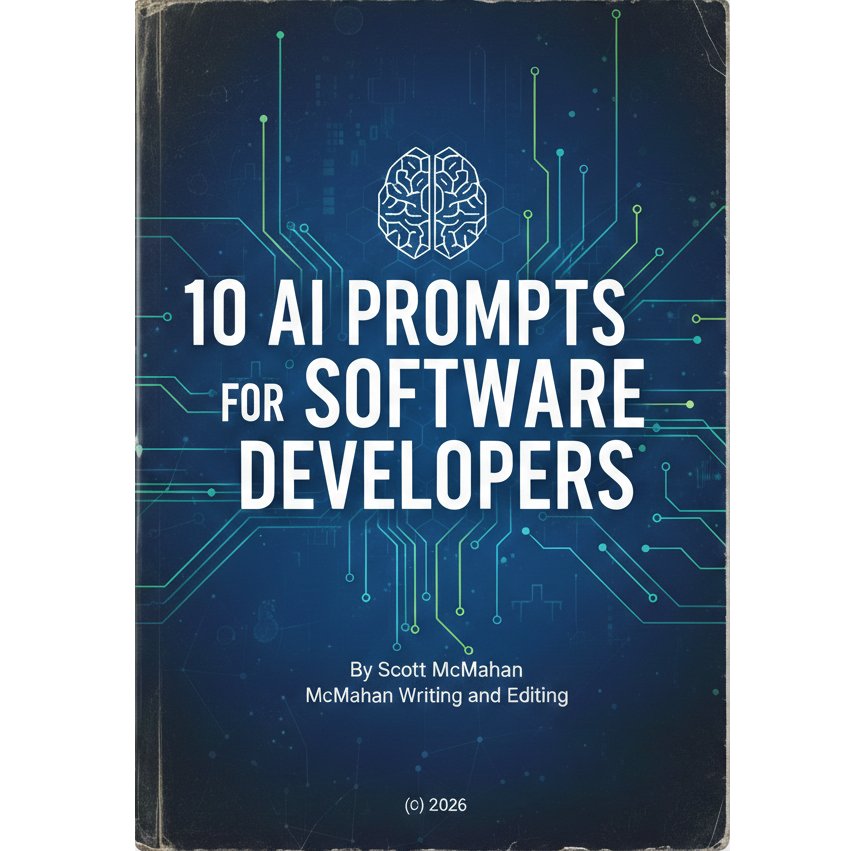
Description
This free 11-page guide gives you ten structured, ready-to-use prompts covering the tasks that eat up developer time every week. Each one is grounded in current prompt engineering research, including work published in 2026, so the techniques behind them reflect where the field actually is right now rather than where it was a few years ago.
Instead of vague requests, you get prompts that work like a well-briefed senior engineer every single time.
What’s Inside
The Code Reviewer prompt turns a quick “look at this” into a structured review covering security, readability, or performance, complete with improved versions of any problematic sections. The Debugging Buddy prompt takes your error message, your code, and what you have already tried, then returns a ranked, step-by-step diagnosis so you stop spinning your wheels. The Documentation Generator produces complete, properly formatted docs covering parameters, return values, edge cases, and usage examples in whatever format your project uses.
Beyond those, you get the Architecture Advisor for comparing real design options against your actual constraints, the Test Case Generator for building full test suites in minutes, the Refactoring Coach for cleaning up legacy code safely, the API Designer for producing complete RESTful specs in one shot, the Performance Optimizer for prioritized bottleneck analysis, the Security Auditor for systematic vulnerability scanning, and the Learning Accelerator for picking up new technologies faster by building on what you already know.
Every Prompt Comes With a Real Case Study
Reading about a prompt is one thing. Seeing it solve a real problem is another. Every section includes a detailed case study showing how a developer used that exact prompt in a real situation and what happened as a result. Marcus caught two SQL injection vulnerabilities before a fintech launch and cut his review turnaround by 40 percent. Priya resolved a two-day React debugging nightmare in about twenty minutes. Elena documented 40-plus undocumented functions in two hours and launched her open-source library to 200 GitHub stars in its first month.
Research-Backed and Up to Date
The techniques behind these prompts draw on peer-reviewed and conference-published research, including Chen et al. (2026) on promptware engineering as a software discipline, Korn et al. (2026) from the FORGE conference on how prompts are built and evaluated in real software engineering practice, Schulhoff et al. (2025) whose landmark survey catalogues 58 distinct prompting techniques, Sahoo et al. (2025) on prompt engineering methods across large language models, and Wei et al. (2022) on chain-of-thought prompting, which remains the foundational citation for sequential reasoning techniques across the current literature. Full APA citations with working links to each source are included in the guide.
The guide includes a clickable table of contents, a static table of contents for print, and clean formatting throughout. Download it, open it, and start using it today.
© 2026 McMahan Writing and Editing | All Rights Reserved.

Reviews
There are no reviews yet.