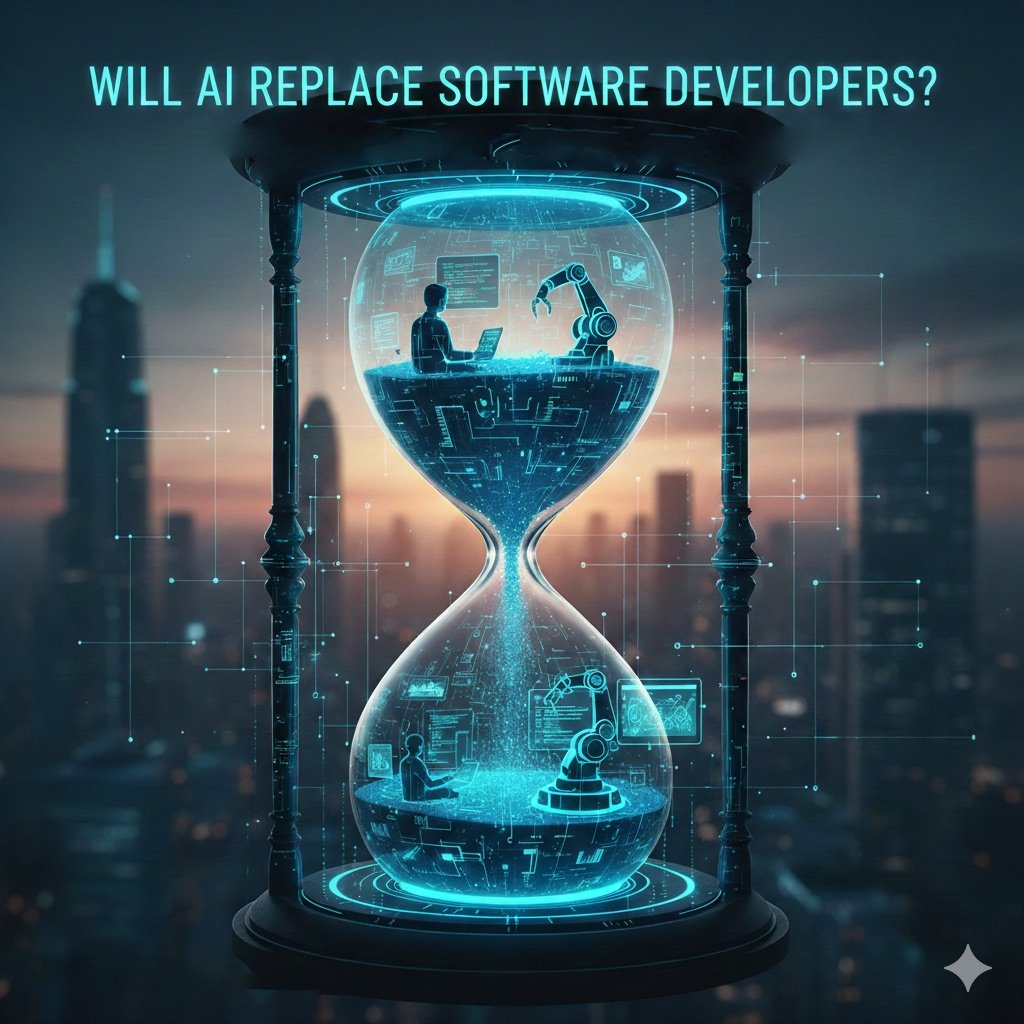

The panic is real. I see it in Reddit threads, LinkedIn posts, and developer Discord channels: “Is AI going to take my job?” So, the main question on every developer’s mind is, ” Will AI replace software developers?” “The unemployment rate for recent computer engineering graduates is now 7.5%, well above the national average of 4.3% (Rak, 2025a). Entry-level hiring at the 15 biggest tech firms fell 25% from 2023 to 2024 (SignalFire, 2024, as cited in Rak, 2025a). And perhaps most alarming, U.S. programmer employment dropped 27.5% between 2023 and 2025 (U.S. Bureau of Labor Statistics, 2025, as cited in Rak, 2025a).
The headlines write themselves: “Goodbye, $165,000 Tech Jobs. Student Coders Seek Work at Chipotle” (New York Times, 2025, as cited in Stack Overflow, 2025).
But here’s what those headlines miss: while programmer jobs are declining, software developer jobs fell only 0.3% in the same period (Rak, 2025a). Positions for information security analysts and AI engineers are increasing (Rak, 2025a). And Morgan Stanley Research predicts the software development, rising from $24 billion in 2024 to $61 billion by 2029 (Singh, 2025).
So what’s really happening? AI isn’t replacing developers. It’s replacing a certain kind of developer—and creating massive opportunities for those who adapt.
The Great Unbundling of Developer Work
To understand what’s happening, we need to recognize that “software developer” was never one job—it was always a bundle of tasks masquerading as a single role. At one end were the routine tasks that occupied the first few years of most developers’ careers: writing boilerplate CRUD code, converting designs into basic HTML and CSS, fixing simple bugs, writing basic unit tests, and documenting straightforward functions. These were the tasks that made you feel productive, that gave you minor victories, that built your confidence as you climbed the ladder.
On the other end were the complex tasks that separated senior developers from juniors: architecting scalable systems, making critical technical decisions with incomplete information, understanding messy business requirements and translating them into elegant solutions, debugging complex interconnected systems where the error might be three layers deep, and reviewing code not just for syntax but for security vulnerabilities and edge cases that only experience can teach you to see.
AI is spectacularly good at the first category. GitHub Copilot now generates an average of 46% of all code written by active users—up to 61% for Java developers (Quantumrun Foresight, 2026a). Developers using Copilot complete tasks 55% faster (Second Talent, 2025), and pull request times have dropped from 9.6 days to 2.4 days in some organizations (Quantumrun Foresight, 2026a). If you handed an AI assistant the typical tasks from a 2020 junior developer job description, it would crush them.
But here’s the critical insight: AI is terrible at the second category. And that second category? That’s where all the value lives. That’s where companies make or lose millions based on the decisions you make. Moreover, that’s where your career actually grows, even if you didn’t realize it at the time.
The Numbers Tell a Story—If You Look Closely
The employment data uncovers a pattern that makes perfect sense once you see it. Junior developer roles are getting hammered. Employment for software developers aged 22-25 has declined nearly 20% from its peak in late 2022 (Stack Overflow, 2025). As one senior software engineer bluntly explained the logic: “Why hire a junior for $90K when GitHub Copilot costs $10?” (Agrawal, 2025, as cited in CIO, 2025). The math is brutal and simple.
But senior roles remain strong—surprisingly so. For workers aged 35-49 in AI-exposed jobs such as software engineering, employment has increased by 9% (Stack Overflow, 2025). Companies aren’t eliminating development teams. They’re restructuring them, cutting the bottom rung and keeping the experienced talent who can architect systems, make judgment calls, and translate business needs into technical solutions.
Meanwhile, the skills gap isn’t closing—it’s widening. While basic coding is increasingly automated, demand for developers who can work with AI has increased substantially. By early 2025, GitHub Copilot had over 15 million users, representing a 400% year-over-year increase (Nadella, 2025, as cited in TechCrunch, 2025). Fortune 100 companies show 90% adoption rates (AboutChromebooks, 2026). The tools are standard now. They’re table stakes. The question isn’t whether you use them—it’s whether you use them effectively.
The job descriptions themselves tell the story. Morgan Stanley Research notes: “As AI coding assistants and agents become standard tools in development workflows, the role of traditional software engineers is likely to shift to more complex applications” (Singh, 2025, para. 3). Today’s postings don’t ask for “5 years of React experience”—they ask for “ability to architect AI-enhanced workflows” and “experience validating AI-generated code.” The emphasis has shifted from coding to orchestration, from implementation to architecture, from doing the work to directing it.
What the Adapters Are Doing
Walk into any successful tech company in 2026, and you’ll find developers who’ve figured out how to succeed in this new landscape. They’re not fighting against AI—they’re leveraging it in ways that make them irreplaceable.
Nearly 80% of new GitHub users now use Copilot in their first week (Microsoft Azure, 2025), but there’s a significant difference between using it and using it well. The developers who are thriving do not blindly accept AI recommendations. They’ve learned to craft precise prompts that generate exactly the code they need, rather than merely approximate code that requires extensive rework. Also, they’ve developed an instinct for recognizing when AI is hallucinating or generating security vulnerabilities—the same way experienced developers can smell code that will cause problems six months down the line.
Furthermore, those who are thriving use AI to generate multiple approaches to the same problem, then select the best one based on factors the AI can’t understand: team conventions, future maintainability, and performance requirements that aren’t explicitly stated. Most importantly, they leverage AI for the boring stuff while focusing their mental energy on architecture and the big-picture decisions that AI simply can’t make.
As one senior engineer describes the evolution: “My role has shifted from just coding to validating AI output, checking for edge cases, security risks, and logic gaps that AI can’t catch” (Agrawal, 2025, as cited in CIO, 2025, para. 8). This isn’t a diminishment of the role—it’s an elevation. Instead of spending hours on boilerplate, these developers focus on the parts that actually matter.
Prompt Engineering as a Core Skill
The rise of prompt engineering as a core competency illustrates this shift perfectly. LinkedIn data shows a 250% increase in job postings mentioning prompt engineering skills (Refonte Learning, 2025). But here’s what’s interesting: companies aren’t hiring “prompt engineers” as a separate role. They’re hiring developers who can also communicate effectively with AI. It’s become a complementary skill, like understanding version control or knowing how to write tests. Successful developers understand how to structure prompts to produce consistent, high-quality outputs; when to break complex tasks into smaller, AI-friendly chunks; how to provide ample context without burdening the model; and, most critically, which tasks should be automated and which require human decision-making.
Human Skills and What AI Strategies Work
The developers who are thriving have also doubled down on the skills that AI struggles with. They recognize that AI can write a function, but it can’t design a system that will scale to millions of users while remaining maintainable. AI can implement a feature, but it can’t determine whether that feature actually solves the business problem or understand the trade-offs involved in different approaches. Also, AI can generate code quickly, but it can’t reliably catch subtle bugs, security vulnerabilities, or architectural problems—in fact, 29.1% of Python code generated by AI contains potential security weaknesses (Quantumrun Foresight, 2026b). AI can write documentation, but it can’t facilitate the messy, complex conversations between product, design, and engineering that lead to great products. And while AI can apply known patterns, it can’t invent novel solutions to unprecedented problems.
Perhaps the best mental model comes from treating AI like an extremely fast, somewhat unreliable junior developer. You wouldn’t let a junior developer push code to production without review. In the same way, you wouldn’t trust them with security-critical systems. You wouldn’t expect them to understand business context and make architectural decisions. But you would have them handle boilerplate, generate test cases, refactor repetitive code, and draft documentation—all under your supervision. That’s exactly how successful developers use AI in 2026.
The Brutal Truth About Career Progression
Here’s what nobody wants to say out loud: the traditional developer career ladder is broken. It used to work like clockwork. First, you’d start as a junior developer, spending two to three years writing simple code, fixing bugs, and learning the ropes. Then you’d advance to mid-level, handling complex features and mentoring the junior staff behind you for another three to five years. Finally, you’d reach senior level, where you’d architect systems and make technical decisions, drawing on five-plus years of accumulated experience and pattern recognition.
AI has collapsed that first step entirely. Companies can now skip hiring juniors and have their mid-level developers use AI to handle junior-level tasks 10 times faster. The entry point has moved up, and there’s no clear path for new developers to gain that foundational experience that used to come from grunt work.
But here’s the opportunity that’s easy to miss if you’re already a working developer: you can leverage AI to accelerate your own progression in ways that weren’t possible before. Instead of spending your time on the grunt work, you can use AI to handle it and spend your time on the activities that actually make you senior. You can focus on reading and appreciating complex codebases, making architectural decisions with real stakes, learning multiple technologies and seeing the patterns between them, understanding the business domain deeply enough to make intelligent trade-offs, building relationships with product and design teams that lead to better outcomes, and mentoring others, even if there aren’t as many juniors to mentor.
The developers who understand this are compressing career timelines. They’re reaching senior-level thinking in 3 years rather than 6 because they’re not spending half their time on tasks that AI can now handle.
Will AI Replace Software Developers? Not If You Build These Skills
The shift in what matters is already visible in hiring patterns and salary data. Python proficiency has become non-negotiable; it remains the dominant language for AI programming, appearing in the vast majority of AI job postings (Rak, 2025b). If you’re not fluent in Python, make it a priority to become fluent. But it’s not only about syntax anymore.
You need a working understanding of how AI and machine learning systems actually function. You don’t need a PhD, but you do need to understand how large language models work, their limitations, and their capabilities. When an AI assistant suggests something, you need to know why it might be wrong. You need to understand the difference between a hallucination and an authentic creative solution. This knowledge is what separates developers who use AI as a crutch from those who use it as a force multiplier.
Differentiators Among Software Developers
System design and architecture have become the primary differentiators. This is where humans still dominate, and where AI struggles to compete. Study distributed systems, scalability patterns, database design, and API architecture. These are the skills that command premium salaries because they prevent million-dollar mistakes.
Security awareness has paradoxically become more important as AI generates more code. Therefore, someone needs to review that code for vulnerabilities, and AI isn’t reliable enough to check its own work. So, learn to spot common vulnerabilities and understand secure programming practices. As the volume of AI-produced code increases, the value of someone who can audit it intelligently increases proportionally.
Domain expertise might be the most underrated skill on this list. Pick an industry—healthcare, finance, e-commerce, whatever interests you—and become an expert in its problems, regulations, and constraints. AI can generate code all day long, but it can’t understand HIPAA compliance requirements or why your fintech app needs to handle exactly this edge case in exactly this way because of a regulation passed in 2018 that most developers have never heard of.
Finally, communication and joint effort matter more, not less. As the technical work becomes more abstracted and automated, the human skills become the differentiators. Can you explain technical trade-offs to layperson stakeholders in a way that helps them make informed decisions? Are you able to facilitate productive disagreements between engineering and product? Also, can you translate vague business requirements into concrete technical specifications? These skills can’t be automated, and they’re increasingly what separates a senior developer from a mid-level one.
The Way Forward
The software development industry isn’t shrinking—it’s transforming. Noteably, Morgan Stanley’s research projects 20% annual growth through 2029 (Singh, 2025). McKinsey expects AI to create more jobs than it eliminates, notably in sectors like AI development services, systems design, and applied machine learning (Netcorp Software Development, 2025). The demand for software developers is growing exponentially. But the nature of “building software” is changing.
Those jobs will go to developers who can work with AI, not to those who compete against it. Therefore, the developers who thrive will be those who recognize that the game has changed and change their strategy accordingly. They’ll spend this month starting to use GitHub Copilot, Cursor, or Claude Code daily, dedicating 30 minutes to learning prompt engineering techniques, and honestly auditing their current skills to understand what percentage of their skills are automatable. Also, they’ll spend this quarter deep-diving into one AI tool or framework, such as LangChain, TensorFlow, or PyTorch, building a project that uses AI as a component rather than just a code generator, and studying system architecture through books like “Designing Data-Centric Applications.” They’ll spend this year becoming the AI expert on their team, developing deep domain knowledge in their industry, and building a portfolio that demonstrates AI-augmented development.
Those Who Recognize AI as a Tool Can Thrive
The developers who will thrive in the AI era aren’t those with the most years of experience or the most languages on their resume. They’re not necessarily the fastest coders or the ones who’ve mastered the most algorithms. They’re the ones who recognize that the game has changed—and change their tactics accordingly. Additionally, they’re the ones who see AI not as a threat to their livelihood but as a tool that lets them focus on what they do best: solving complex problems, making judgment calls with incomplete information, and building systems that create real value.
AI won’t replace developers. But developers who leverage AI will replace developers who don’t. The choice, as always, is yours. The question is: which side of that divide will you be on?
References
AboutChromebooks. (2026). GitHub Copilot statistics [2026]. https://www.aboutchromebooks.com/github-copilot-statistics/
CIO. (2025, September 24). Demand for junior developers softens as AI takes over. https://www.cio.com/article/4062024/demand-for-junior-developers-softens-as-ai-takes-over.html
Microsoft Azure. (2025, October 30). Developer innovation at the center of GitHub Universe 2025. https://azure.microsoft.com/en-us/blog/github-universe-2025-where-developer-innovation-took-center-stage/
Netcorp Software Development. (2025). Will AI replace programmers? The future of coding in the age of AI. https://www.netcorpsoftwaredevelopment.com/article/will-ai-replace-programmers
Quantumrun Foresight. (2026a, January 9). GitHub Copilot statistics 2026. https://www.quantumrun.com/consulting/github-copilot-statistics/
Quantumrun Foresight. (2026b, January 9). A GitHub research study on code quality was published in November 2024. In GitHub Copilot statistics 2026. https://www.quantumrun.com/consulting/github-copilot-statistics/
Rak, G. (2025a, December 29). AI shifts expectations for entry-level jobs. IEEE Spectrum. https://spectrum.ieee.org/ai-effect-entry-level-jobs
Rak, G. (2025b, April 17). AI jobs in 2025: Essential insights for software engineers. IEEE Spectrum. https://spectrum.ieee.org/ai-jobs-in-2025
Refonte Learning. (2025). Prompt engineering trends 2025 — Skills you’ll need to stay competitive. https://www.refontelearning.com/blog/prompt-engineering-trends-2025-skills-youll-need-to-stay-competitive
Second Talent. (2025, October 28). GitHub Copilot statistics & adoption trends [2025]. https://www.secondtalent.com/resources/github-copilot-statistics/
SignalFire. (2024). [Entry-level hiring data at 15 biggest tech firms]. In G. Rak, AI shifts expectations for entry-level jobs. IEEE Spectrum. https://spectrum.ieee.org/ai-effect-entry-level-jobs
Singh, S. (2025). AI in software development: Creating jobs and redefining roles. Morgan Stanley Insights. https://www.morganstanley.com/insights/articles/ai-software-development-industry-growth
Stack Overflow. (2025, December 26). AI vs Gen Z: How AI has changed the career pathway for junior developers. https://stackoverflow.blog/2025/12/26/ai-vs-gen-z/
TechCrunch. (2025, July 31). GitHub Copilot crosses 20M all-time users. https://techcrunch.com/2025/07/30/github-copilot-crosses-20-million-all-time-users/
U.S. Bureau of Labor Statistics. (2025). [Programmer employment data 2023-2025]. In G. Rak, AI shifts expectations for entry-level jobs. IEEE Spectrum. https://spectrum.ieee.org/ai-effect-entry-level-jobs
About the Author: This post is part of the AITransformer series helping tech professionals survive and thrive in the AI era. Follow for weekly insights about navigating your tech career in 2026 and beyond.